
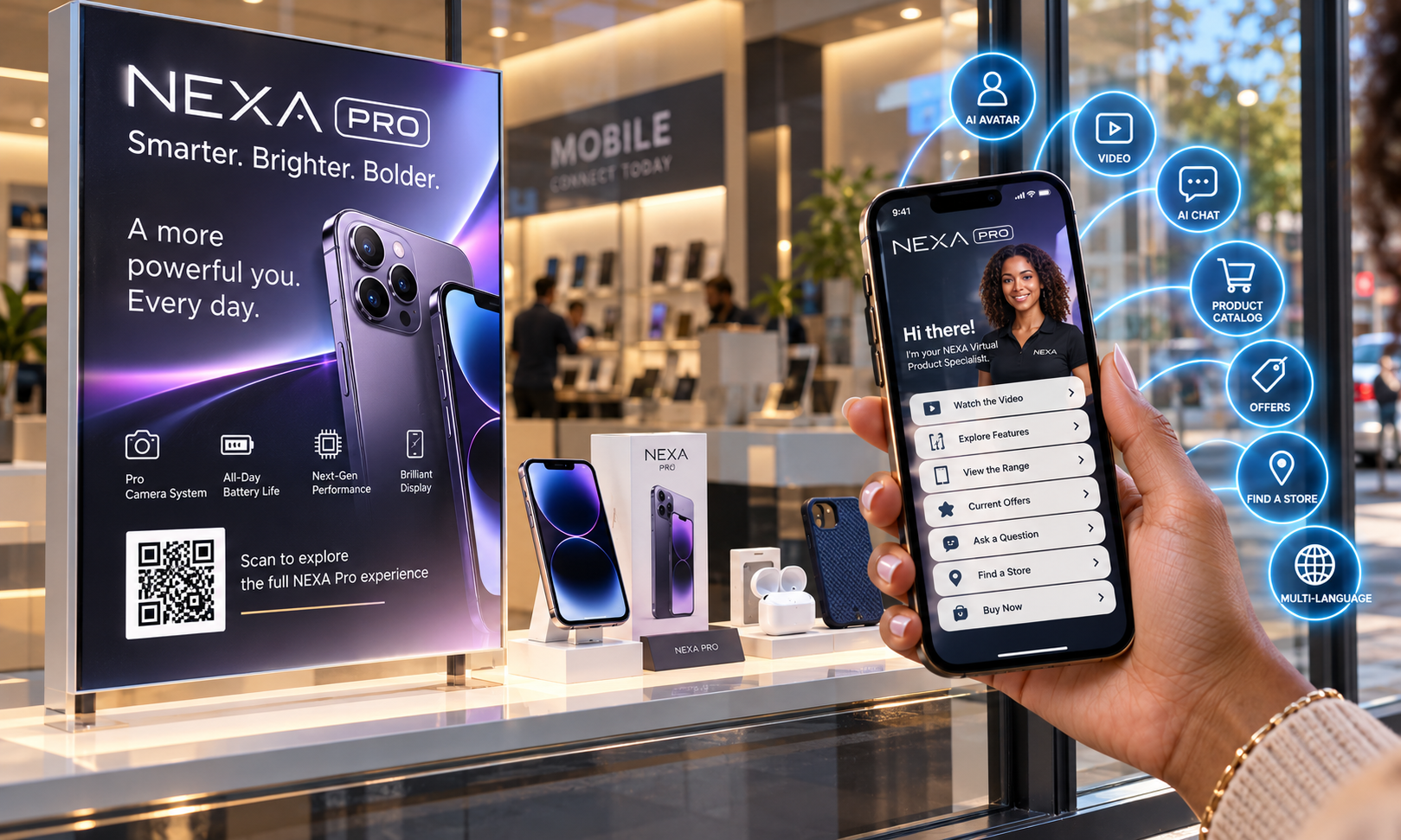
AI-Enhanced Window Signage (Retail Marketing)
Campaign Type: AI-Enhanced Retail Customer Engagement & Sales Campaign
Audience: Retail Shoppers, Passersby & Prospective Customers
Delivery Method: Retail Window Signage & Promotional Window Displays
Experience Type: AI Digital Twin Virtual Salesperson + Interactive Product Discovery + Direct Shopping & Enquiries
Technologies: Dynamic QR Codes, Augmented Reality (WebAR), AR Avatars, AI Chatbot, Interactive Video, WebAR Catalog, Landing Pages, Geo-Specific Content, Multilingual Content, Digital Retargeting, Reporting Dashboard
Overview
This Use Case illustrates how AI-Enhanced Window Signage could transform a traditional retail window display into an intelligent, interactive customer engagement and sales channel that remains available even when the store is closed.
Retail window displays already perform an important role. They capture attention, showcase products, communicate promotions, and encourage people to enter a store.
But what happens when someone notices a product after business hours?
The window may generate interest, but the opportunity to engage with that potential customer can easily be lost.
AI-Enhanced Window Signage could change that.
By incorporating a Dynamic QR Code into the window display, retailers could connect passersby directly to an interactive digital experience built around the products, services, or promotions being advertised.
Customers could meet an AI-powered Digital Twin Virtual Salesperson, watch product demonstrations, ask questions through an AI Chatbot, browse an interactive product catalog, access current offers, and purchase products, book appointments, or submit enquiries directly from their smartphones.
The experience could also provide multilingual content, relevant product recommendations, and direct access to online shopping.
For retailers, the window could become an always-available customer engagement and sales channel.
For signage providers and marketing agencies, it would create an opportunity to deliver a higher-value solution that extends beyond the design, production, and installation of traditional signage.
The store may close, but the opportunity to engage and sell could remain open.
Campaign Background
Retailers invest considerable resources in creating attractive storefronts and window displays.
A well-designed window can showcase merchandise, reinforce brand positioning, communicate promotions, and encourage passing shoppers to stop and look.
For many retailers, window signage is also one of the most visible marketing assets they own.
It can be seen by pedestrians, commuters, tourists, and other potential customers throughout the day and evening.
However, traditional window signage is largely passive.
It communicates a message but generally cannot respond when someone becomes interested.
A passerby may notice a product and want to know more about its features, available sizes, colors, pricing, or current promotions.
They may want to see the product demonstrated, compare alternatives, or purchase it immediately.
When the store is open, a salesperson may be available to assist.
When the doors are closed, the customer is typically left to search for information independently or return another time.
AI-Enhanced Window Signage would create a direct connection between the attention generated by the physical display and an interactive customer experience.
The printed signage would continue attracting attention.
The digital experience would provide the information, assistance, and purchasing pathways needed to turn that attention into action.
Challenge
In this illustrative scenario, introducing AI-Enhanced Window Signage would aim to:
- Extend customer engagement beyond normal trading hours
- Transform passive window displays into interactive sales opportunities
- Provide immediate access to product information and demonstrations
- Allow customers to ask questions without entering the store
- Create a more engaging connection with the retailer’s brand
- Showcase a wider product range than the physical display can accommodate
- Promote current offers without repeatedly replacing printed signage
- Support multilingual customer engagement
- Enable purchases, bookings, and enquiries directly from the window experience
- Generate measurable insight into customer interests and interactions
The objective would not be to replace traditional window displays.
It would be to make them more valuable by connecting the physical retail environment with the convenience and functionality of digital commerce.
Solution
The AI-Enhanced Window Signage campaign could function in the following way:
Interactive Retail Window Display
A Dynamic QR Code could be incorporated into a professionally designed window display promoting a featured product, product range, or retail campaign.
The display could include a compelling call-to-action such as:
“Our Store May Be Closed. Your Shopping Experience Isn’t. Scan to Explore.”
Or:
“Meet Your 24/7 Virtual Salesperson. Scan to Discover More.”
Scanning the QR Code would launch a mobile-optimized digital experience directly in the customer’s browser.
No app download would be required.
The physical signage would attract attention, while the digital experience would provide the opportunity to explore, engage, and act.
AI Digital Twin Virtual Salesperson
The experience could feature an AI-powered Digital Twin of a real salesperson, store representative, or brand ambassador.
Using Augmented Reality, the Virtual Salesperson could appear within the customer’s environment and introduce the products being promoted.
The Digital Twin could:
- Welcome the customer
- Introduce the retailer or brand
- Highlight featured products
- Explain key product benefits
- Direct customers to demonstrations
- Introduce current promotions
- Encourage product exploration
- Guide customers toward shopping or enquiry options
The experience could provide a more personal introduction than a conventional product webpage.
Importantly, the Digital Twin would not replace the retailer’s sales team.
It would extend the brand’s presence beyond normal trading hours, allowing customers to engage with the retailer whenever they encounter the window display.
Interactive Product Demonstrations
Customers could access videos and interactive content demonstrating the products featured in the window.
Depending on the retail category, this could include:
- Product demonstration videos
- Feature explanations
- Product comparisons
- Interactive 3D models
- Augmented Reality product experiences
- Styling or usage examples
- Product care information
- Customer testimonials
For example, a customer viewing a home appliance in the window could watch a demonstration of how it works, explore its features, and compare available models.
A fashion retailer could showcase different styles, colors, and related accessories.
A furniture retailer could provide interactive 3D product views or suitable Augmented Reality visualization.
The physical display would generate interest.
The interactive experience would provide the depth needed to help customers evaluate their options.
AI Shopping Assistant
An integrated AI Chatbot could allow customers to ask questions about the products, services, and offers being promoted.
Questions could include:
- What colors are available?
- Does this product come in different sizes?
- What are the main features?
- Are there similar products?
- Is this item available online?
- Are there any current promotions?
- Can I arrange a demonstration?
- How do I purchase this product?
- When does the store reopen?
The AI Chatbot could draw from approved product and retailer information, providing relevant answers and directing customers toward appropriate next steps.
Where live stock, pricing, or other operational information was required, the experience could connect to an appropriate retailer system or direct the customer to the relevant product page.
This would allow customers to explore the products conversationally rather than searching through multiple webpages.
Interactive Product Catalog
The experience could also provide access to an interactive product catalog.
Rather than limiting the customer’s attention to the few products physically displayed in the window, the retailer could introduce a broader selection.
Customers could:
- Browse product categories
- Explore featured collections
- View product images and videos
- Compare available options
- Discover complementary products
- Access current promotions
- Select products for purchase
This could be particularly valuable for retailers with extensive product ranges or limited window display space.
The window could become the gateway to a much larger shopping experience.
Current Promotions & Offers
AI-Enhanced Window Signage could provide customers with access to relevant promotions and offers.
These might include:
- Featured product discounts
- Seasonal promotions
- Limited-time offers
- Product bundles
- Loyalty benefits
- New product launches
- Exclusive window-display promotions
Because the QR Code would be dynamic, the retailer could update the digital experience as promotions change.
The physical signage would not necessarily need to be replaced every time the featured offer or product information changed.
This could extend the useful life of the printed display while allowing the digital campaign to remain current.
Direct Shopping & Purchasing
One of the most commercially valuable aspects of AI-Enhanced Window Signage would be the ability to connect product interest directly with a purchase opportunity.
Customers could move from the window experience to:
- Product pages
- Online shopping carts
- Secure checkout
- Click-and-collect options
- Product reservations
- Appointment bookings
- Sales enquiries
Where supported by the retailer’s eCommerce platform, customers could complete a purchase without waiting for the store to reopen.
The window could therefore generate sales opportunities beyond normal business hours.
Personalized Product Recommendations
The experience could also help customers discover products relevant to their interests.
Based on choices made during the session, customers could be guided toward:
- Similar products
- Alternative models
- Complementary accessories
- Related collections
- Relevant promotions
- Appropriate product bundles
For example, someone exploring a featured home appliance could be introduced to compatible accessories or alternative models.
A customer viewing a fashion display could explore complementary items from the same collection.
This would create opportunities for product discovery, cross-selling, and upselling without requiring additional physical display space.
Multilingual Customer Engagement
Retail locations may attract customers who speak different languages, particularly in shopping precincts, tourist destinations, and international retail environments.
The digital experience could allow customers to select their preferred language.
Depending on the available content, this could include:
- Product information
- Virtual Salesperson content
- AI Chatbot assistance
- Product demonstrations
- Shopping instructions
- Customer support information
This would allow retailers to create a more accessible customer experience without overcrowding the physical window display with multiple languages.
Geo-Specific Content
For retailers operating multiple locations, Geo-Specific Content could help present information relevant to the store or area where the customer engages.
This could include:
- Store-specific promotions
- Local contact details
- Relevant product collections
- Nearby store information
- Local events
- Regional campaign content
A default experience could be provided where location-specific information was unavailable or unnecessary.
This would allow a broader retail campaign to maintain local relevance.
Digital Retargeting
Where appropriate and subject to relevant consent and privacy requirements, customers who interact with the window experience could also be included in a connected Digital Retargeting journey.
Follow-up advertising could reinforce:
- Products explored
- Current promotions
- Related product recommendations
- New collections
- Relevant shopping opportunities
- Brand awareness
This could help extend the customer relationship beyond the initial interaction with the window display.
Engagement & Sales Reporting
Traditional window signage can attract attention, but understanding what happens after someone notices the display can be difficult.
AI-Enhanced Window Signage could provide measurable insight into how customers interact with the experience.
Reporting could include:
- QR Code scans
- Unique and repeat engagement
- Digital Twin views
- Product demonstrations watched
- AI Chatbot interactions
- Product catalog activity
- Engagement duration
- Promotions explored
- Calls-to-action selected
- Shopping and enquiry pathway engagement
Where supported by appropriate eCommerce or CRM integration, retailers could also connect selected customer actions with subsequent enquiries or purchases.
This could help retailers understand which products generate interest, which content encourages engagement, and which experiences contribute to customer action.
It would also provide signage providers and agencies with a more meaningful way to demonstrate the ongoing value of their solution.
Why AI-Enhanced Window Signage Works
AI-Enhanced Window Signage would work because it would transform an existing retail marketing asset into an interactive customer engagement channel.
Retailers already invest in window displays to attract attention and showcase products.
The opportunity would be to extend the value of that investment.
A traditional window display can show customers what is available.
An AI-enhanced experience could help them understand the product, ask questions, explore alternatives, access promotions, and take the next step.
The AI Digital Twin would create a more engaging introduction to the brand. The AI Chatbot could provide immediate assistance. Interactive product demonstrations could help customers evaluate their options, while the digital catalog could extend the range of products available for exploration.
Most importantly, the experience would remain accessible even when the physical store was closed.
A customer walking past in the evening could still discover products, access relevant information, submit an enquiry, book an appointment, or make a purchase.
For retailers, AI-Enhanced Window Signage could create opportunities to:
- Extend customer engagement beyond trading hours
- Generate additional sales and enquiries
- Improve product discovery
- Promote complementary products
- Increase the value of existing window displays
- Update digital content without repeatedly replacing signage
- Understand customer interests through measurable engagement
For signage providers and marketing agencies, it would create a different kind of commercial opportunity.
Instead of competing primarily on the design, production, and installation of physical signage, they could offer clients a more comprehensive Interactive Print solution.
This could include the initial signage, interactive digital experience, AI functionality, product content, campaign updates, reporting, and ongoing optimization.
The result would be a differentiated service that creates value long after the signage has been installed.
The window would continue attracting attention.
The interactive experience would help turn that attention into action.
Conclusion
AI-Enhanced Window Signage would represent a significant evolution in the role of traditional retail window displays.
By combining professionally produced signage with Dynamic QR Codes, AI Digital Twin Virtual Salespeople, AI Chatbots, interactive product demonstrations, digital catalogs, current promotions, and direct shopping pathways, retailers could create an engaging customer experience available around the clock.
For customers, the window could become a convenient gateway to product information, assistance, and shopping opportunities.
For retailers, it could become an ongoing engagement and sales channel that generates measurable insight into customer interests and actions.
For signage providers and marketing agencies, it would demonstrate how Interactive Print can transform a familiar physical marketing product into a higher-value solution with opportunities for ongoing digital services.
The physical window would remain essential for attracting attention.
The AI-enhanced experience would provide the opportunity to do something with that attention.
A shop window can keep selling after the doors close.
AI-Enhanced Window Signage could turn it into a 24/7 salesperson and sales channel.
That’s Interactive Print.
Contact Us if you’d like to learn more about implementing AI-Enhanced Window Signage into your marketing.