
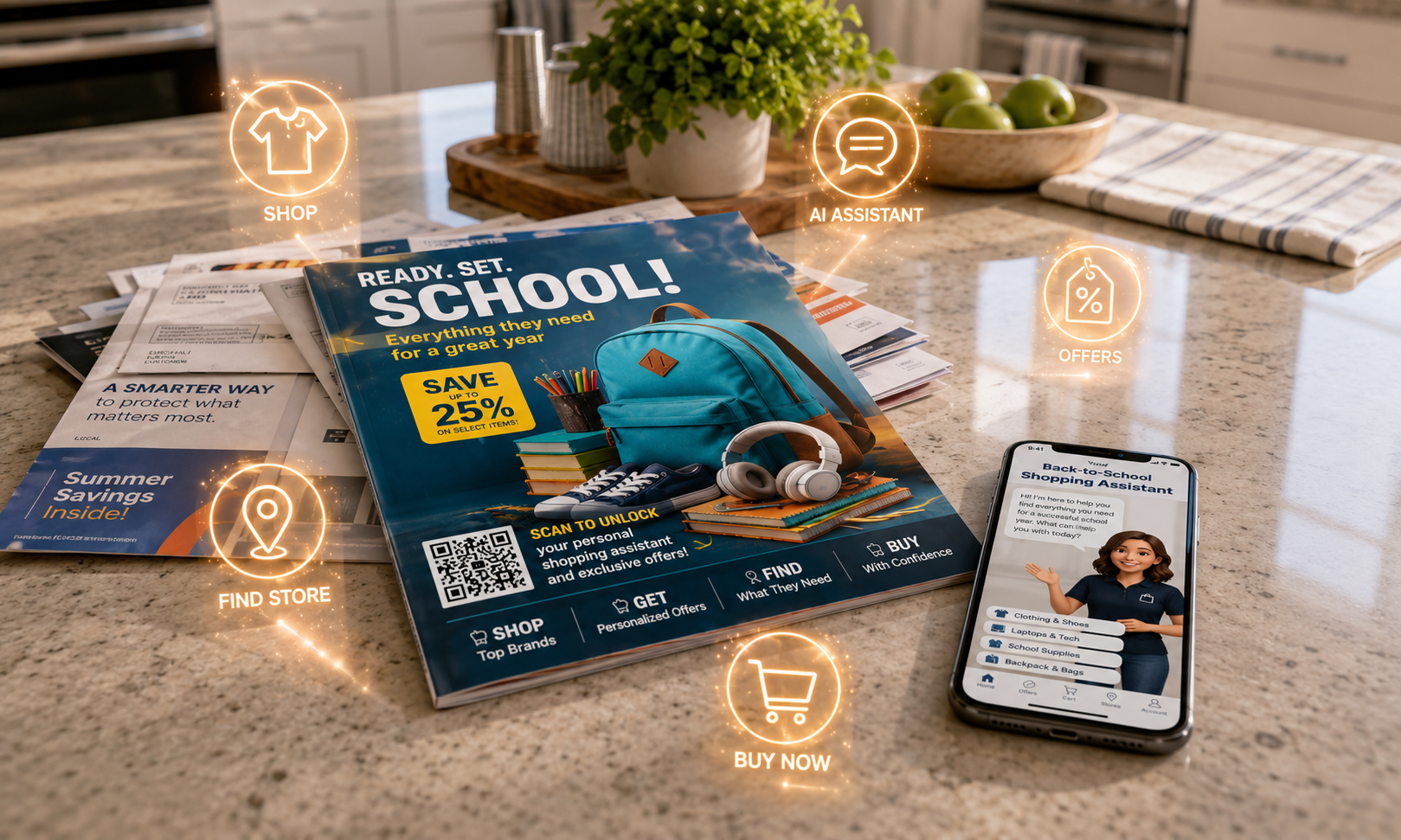
Interactive Retail Catalog
Campaign Type: Interactive Back-to-School Retail Catalog Campaign
Audience: Existing Customers, Loyalty Members, Parents & Back-to-School Shoppers
Delivery Method: Direct Mail (Catalogs, Postcards & Mailers)
Experience Type: Personalized Shopping Experience + AI Shopping Assistant + Direct Purchase Pathways
Technologies: Personalized QR Codes, Personalized Landing Pages, AI Chatbot, Geo-Specific Content, Digital Retargeting, Integrated Email, Reporting Dashboard
Overview
This Use Case illustrates how an Interactive Retail Catalog could transform traditional Back-to-School Direct Mail into a personalized shopping experience designed around each customer.
Back-to-School is one of retail’s most important buying periods, with customers often shopping across multiple categories including clothing, footwear, technology, school supplies, and accessories. While traditional catalogs and mailers can effectively showcase products and promotions, they typically present the same content to every recipient.
An Interactive Retail Catalog would take a different approach.
By combining Personalized QR Codes with customer data, purchase history, preferences, loyalty information, and location, each printed piece could become the gateway to an individualized digital shopping experience.
One quick scan could allow customers to explore relevant products, compare technology, discover recommended bundles, ask an AI Shopping Assistant for help, unlock personalized offers, locate their nearest store, and purchase products directly from their smartphone.
Rather than simply promoting products, the Interactive Retail Catalog would actively help each customer find, choose, and buy what they need.
This approach would combine the reach and visibility of Direct Mail with the personalization, convenience, and intelligence of modern digital commerce, transforming every mail piece into a more relevant path to purchase.
Campaign Background
Back-to-School shopping can be a complex purchasing period for families. Customers may need to buy clothing, footwear, laptops, tablets, stationery, backpacks, and other essential products within a relatively short timeframe.
For retailers, this creates a significant opportunity. It also creates considerable competition for customer attention.
Traditional retail catalogs and Direct Mail campaigns can reach customers directly in their homes and showcase a broad range of products. However, the same catalog may need to appeal to customers with very different requirements.
A family purchasing primary school supplies may have very different needs from a household preparing a student for university. A loyal customer may have different preferences from a new shopper. Previous purchases, preferred brands, location, and loyalty status could all influence which products and offers are most relevant.
An Interactive Retail Catalog would allow the physical mail piece to remain broad and visually engaging while the digital experience behind it becomes significantly more personal.
Instead of expecting every customer to search through the same products, the experience could help guide each individual toward the categories, recommendations, and offers most relevant to them.
This would allow retailers to move beyond mass communication and create a more useful, personalized, and connected Back-to-School shopping journey.
Challenge
In this illustrative scenario, launching an Interactive Retail Catalog campaign would aim to:
- Increase engagement with Back-to-School Direct Mail
- Make large product ranges easier to explore
- Deliver more relevant products, recommendations, and offers
- Reduce friction between product discovery and purchase
- Provide immediate access to shopping assistance
- Connect online shopping with nearby physical store locations
- Capture measurable customer engagement insights
Traditional retail catalogs can generate awareness and product discovery, but customers are often left to navigate the next stage of the shopping journey themselves.
The Interactive Retail Catalog would be designed to bridge that gap by transforming the mail piece into a personalized shopping assistant that actively helps customers move from interest to purchase.
Solution
The Interactive Retail Catalog campaign could function in the following way:
Personalized Interactive Catalog Access
Each customer could receive a catalog, postcard, or mailer featuring a Personalized QR Code unique to them.
When scanned, the Personalized QR Code would recognize the recipient and launch a digital shopping experience tailored to available customer data.
No login or manual identification would be required.
Personalized Product Recommendations
The experience could dynamically present products based on factors such as:
- Previous purchase history
- Product and brand preferences
- Loyalty status
- Customer profile data
- Previous campaign engagement
- Geographic location
A customer who had previously purchased technology products, for example, could be shown relevant laptops, tablets, accessories, or upgrade recommendations. Another customer could receive greater emphasis on clothing, footwear, or school supplies.
This would allow a single Direct Mail campaign to create different digital shopping journeys for different customers.
Interactive Product Exploration
Customers could browse relevant Back-to-School categories including:
- Clothing and footwear
- Laptops, tablets, and technology
- Backpacks and accessories
- Stationery and school supplies
- Product bundles and essential kits
Rather than directing customers to a generic homepage, the Interactive Retail Catalog would take them directly into a more relevant shopping environment.
AI Shopping Assistant
An integrated AI Shopping Assistant could help customers navigate products and make purchasing decisions.
Customers could ask questions such as:
- Which laptop is best for a university student?
- What school supplies are included in this bundle?
- Which products are available within a specific budget?
- What is the difference between two devices?
- Which products would be suitable for a particular age group?
The AI Shopping Assistant could provide immediate guidance, helping customers narrow their options without manually searching across multiple product pages.
Personalized Offers & Recommendations
The experience could also present personalized:
- Discounts
- Loyalty rewards
- Product recommendations
- Bundle offers
- Limited-time promotions
- Cross-sell and upsell opportunities
These offers could be dynamically aligned with the individual customer rather than presenting the same promotion to every recipient.
Direct Purchase Pathways
Products featured within the experience could include clear calls-to-action that allow customers to:
- Add products to cart
- Purchase online
- Save products for later
- Check product availability
- Reserve products for collection
This would significantly shorten the journey between discovering a product and taking action.
Geo-Specific Content
The Interactive Retail Catalog could use location to provide relevant information such as:
- Nearest store locations
- Local product availability
- Store-specific promotions
- Regional Back-to-School offers
- Click-and-collect options
This would help connect the personalized digital experience with the retailer’s physical store network.
Integrated Email
The Interactive Retail Catalog campaign could also connect with Integrated Email to create a coordinated customer journey.
Follow-up communication could be influenced by how the recipient engaged with the mail piece. For example, customers who explored technology products could receive relevant follow-up content, while those who viewed clothing or school supply bundles could receive different communications.
This would create greater continuity between Direct Mail, digital interaction, and subsequent marketing.
Digital Retargeting
Customers who engage with the Interactive Retail Catalog could also receive relevant digital advertising aligned with the products or categories they explored.
This would extend the campaign beyond the initial scan and help maintain visibility throughout the Back-to-School purchasing period.
Engagement Reporting
Interaction data could provide insight into:
- Who engaged
- Which product categories were explored
- Which recommendations were viewed
- How long customers engaged
- Which calls-to-action were selected
- Which offers generated interest
These insights would provide retailers with a deeper understanding of customer interests and campaign engagement beyond traditional response measurement.
Why Interactive Retail Catalog Works
An Interactive Retail Catalog would combine the physical reach and visibility of Direct Mail with the personalization and convenience customers increasingly expect from digital shopping.
Back-to-School customers are not all looking for the same products. Their needs can vary significantly based on age, education level, household requirements, previous purchases, budget, and location.
A traditional catalog can showcase a broad product range, but an Interactive Retail Catalog could help each customer navigate that range more effectively.
Personalized QR Codes would create an immediate connection between the individual and the experience. Personalized Landing Pages would make product discovery more relevant. An AI Shopping Assistant would provide instant guidance, while Geo-Specific Content could connect customers with their nearest store and locally relevant information.
Integrated Email and Digital Retargeting would extend the journey beyond the printed piece, creating a more connected campaign across multiple channels.
Most importantly, the experience would reduce friction.
Customers would spend less time searching for relevant products and more time exploring options suited to their needs. The pathway from receiving the mail piece to finding a product, asking a question, and making a purchase could happen within one connected experience.
Rather than functioning as a static collection of products and offers, the Interactive Retail Catalog would become a personalized shopping platform delivered through print.
Conclusion
The Interactive Retail Catalog would represent a meaningful evolution in Back-to-School retail marketing.
By combining Personalized QR Codes, Personalized Landing Pages, AI-powered shopping assistance, Geo-Specific Content, and direct purchase pathways, retailers could transform traditional catalogs, postcards, and mailers into individualized customer shopping experiences.
Instead of asking every customer to navigate the same product journey, the Interactive Retail Catalog would help each recipient discover products, offers, and recommendations that are more relevant to them.
For customers, this would create a simpler, more convenient, and more personalized way to shop.
For retailers, it would create richer opportunities to engage existing customers, understand their interests, strengthen relationships, and connect product discovery more directly with purchase.
In modern retail marketing, the Interactive Retail Catalog would not simply enhance traditional Direct Mail. It would become the new standard for transforming every mail piece into a personalized path to purchase.
Contact Us if you’d like to learn more about implementing Interactive Retail Catalogs into your marketing.