
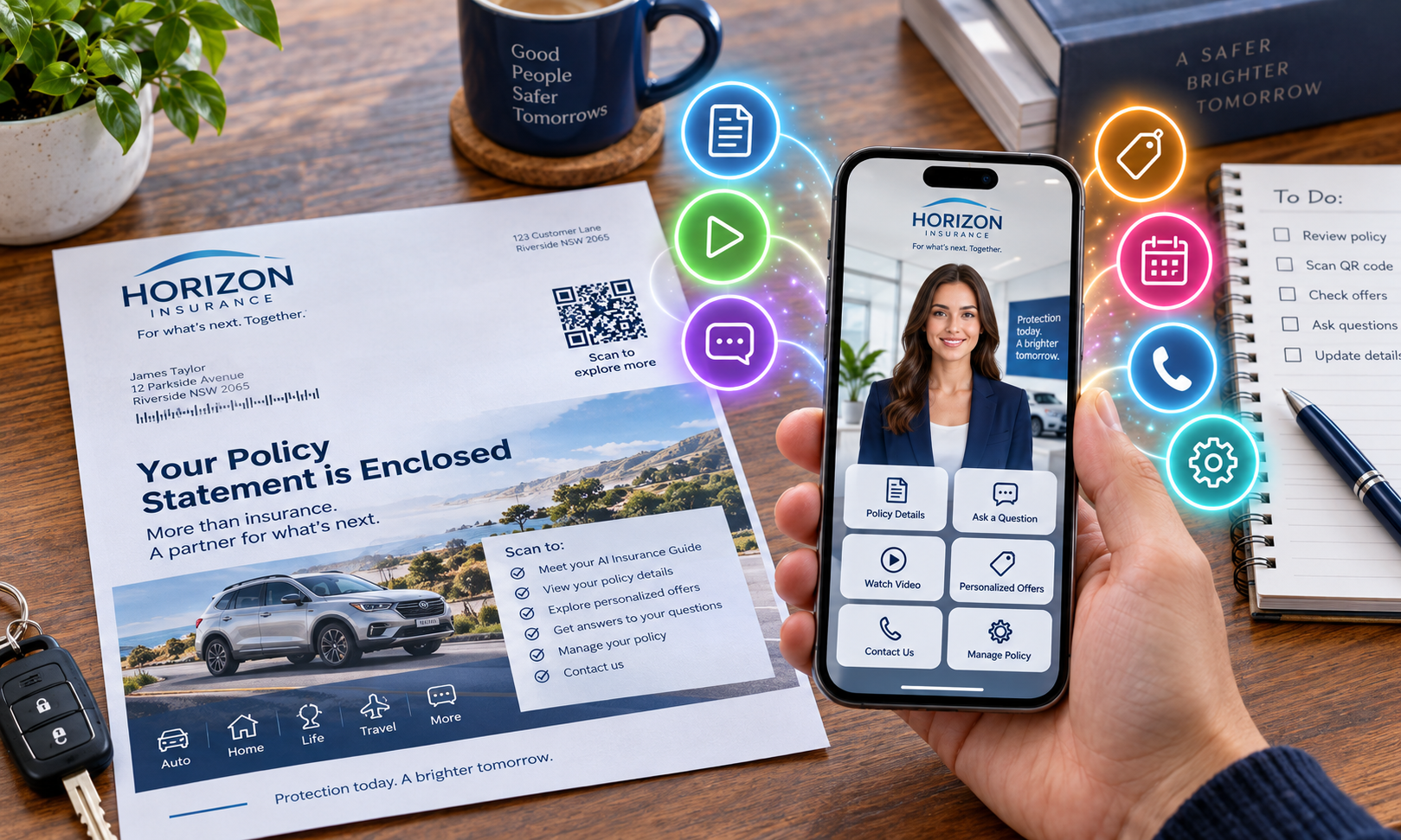
AI-Enhanced Transactional Mail
Campaign Type: AI-Enhanced Customer Communication & Engagement Campaign
Audience: Existing Customers, Members, Account Holders & Service Users
Delivery Method: Transactional Mail
Experience Type: Personalized Customer Experience + AI Assistance + Interactive Response Pathways
Technologies: Personalized QR Codes, Personalized Landing Pages, AI Digital Twin, AI Chatbot, Augmented Reality (WebAR), Interactive Video, Integrated Email, Digital Retargeting, Reporting Dashboard
Overview
This Use Case illustrates how AI-Enhanced Transactional Mail could transform essential customer communications into more helpful, personalized, and interactive brand experiences.
Transactional Mail includes statements, bills, account notices, confirmations, renewals, policy documents, service communications, and other important correspondence that organizations already send to their customers.
Unlike many marketing communications, these printed pieces are often expected, relevant, and likely to receive attention because they contain information relating directly to the recipient.
That creates an important customer experience opportunity.
By integrating a Personalized QR Code into the mail piece, AI-Enhanced Transactional Mail could connect each recipient to a digital experience relevant to both the communication and their individual relationship with the organization.
A recipient could meet an AI-powered Digital Twin, ask questions through an AI Chatbot, watch an explanatory video, access personalized account information, explore relevant products or services, receive an appropriate offer, or move directly to an action such as paying, renewing, booking, registering, or responding.
Rather than treating Transactional Mail purely as an administrative communication, organizations could use Interactive Print to make an existing customer touchpoint more useful.
The mail would still deliver the essential information.
AI-Enhanced Transactional Mail would help turn that information into an experience.
Campaign Background
Organizations across financial services, insurance, telecommunications, utilities, healthcare, membership services, automotive, government, and many other sectors send large volumes of Transactional Mail every year.
These communications serve important operational purposes.
They may provide customers with:
- Statements
- Bills and invoices
- Renewal notices
- Policy information
- Account updates
- Service notifications
- Appointment information
- Membership communications
- Regulatory or administrative notices
Because these communications relate directly to an existing customer relationship, recipients often have questions or need to take a subsequent action.
A customer receiving a renewal notice may want to understand their options. Someone receiving a statement may have a question about a particular item. A member receiving an account update may want to explore additional benefits. A recipient of an appointment notice may need to confirm, change, or access further information.
Traditionally, the printed communication may direct recipients to a website, phone number, or customer portal.
AI-Enhanced Transactional Mail would provide a more direct pathway.
The printed piece could become the starting point for an intelligent digital experience designed around the purpose of the communication and the needs of the recipient.
Challenge
In this illustrative scenario, launching AI-Enhanced Transactional Mail would aim to:
- Make essential customer communications more useful and engaging
- Provide recipients with immediate access to relevant information
- Personalize the experience based on available customer data
- Answer routine questions without requiring recipients to search elsewhere
- Explain complex information through interactive content and video
- Provide clear pathways to relevant customer actions
- Offer multilingual access to approved information
- Introduce relevant products, services, benefits, or offers
- Reduce unnecessary friction within the customer journey
- Capture measurable insight into engagement with printed communications
Transactional Mail will continue to perform an important functional role.
AI-Enhanced Transactional Mail would extend that role by making the communication easier to understand, interact with, and act upon.
Solution
The AI-Enhanced Transactional Mail experience could function in the following way:
Personalized QR Code
Each mail piece could contain a Personalized QR Code unique to the recipient.
Scanning the code would launch a mobile-optimized digital experience without requiring the recipient to manually search for the appropriate webpage.
Because each QR Code could be linked to a unique customer identifier, the experience could recognize which communication had generated the interaction and present relevant content accordingly.
Available mail-list data could also be used to personalize written and digital content based on information appropriate to the campaign.
The QR Code would simply provide access.
The value would be in the personalized experience waiting behind it.
Personalized Customer Experience
Once scanned, the recipient could access a Landing Page tailored to the purpose of the communication.
Depending on the campaign, this could include:
- A personalized greeting
- Relevant account or service information
- Explanations of the communication
- Important dates or next steps
- Relevant customer benefits
- Personalized offers
- Frequently requested information
- Clear calls-to-action
Instead of sending every customer to a generic webpage, the digital experience could help prioritize the information most relevant to that recipient.
AI-Powered Digital Twin
An AI-powered Digital Twin could provide a more human introduction to the communication.
The Digital Twin could represent an appropriate customer service, account, membership, or brand representative and could:
- Welcome the recipient
- Explain the purpose of the communication
- Highlight important information
- Introduce available options
- Direct the recipient toward relevant resources
- Explain available products or services
- Encourage an appropriate next action
This would allow organizations to add a more engaging and personal layer to communications that may otherwise feel purely administrative.
AI Chatbot Support
An integrated AI Chatbot could allow recipients to ask general questions relating to the communication, organization, products, services, or approved support information.
Depending on the application, questions could include:
- What does this notice mean?
- What are my renewal options?
- How can I make a payment?
- Where can I find more information?
- How can I update my details?
- What services are available?
- How do I book an appointment?
- How can I contact customer service?
The AI Chatbot could be grounded in approved organizational information and configured around the specific communication experience.
Where a question required access to sensitive information, specialist advice, or direct customer service intervention, the experience could guide the recipient toward the appropriate secure or human-assisted channel.
Interactive Video Content
Some information will be easier to understand when it is explained visually.
AI-Enhanced Transactional Mail could provide access to videos that:
- Explain the communication
- Introduce changes to a service
- Demonstrate how to complete an action
- Explain membership or customer benefits
- Introduce relevant products or services
- Provide helpful educational information
This could make complex or unfamiliar information easier for recipients to understand without overcrowding the printed communication.
Personalized Information & Offers
Transactional communications could also create opportunities to present additional information that is relevant to the existing customer relationship.
Depending on the organization and available customer data, this could include:
- Relevant service options
- Customer benefits
- Renewal alternatives
- Product upgrades
- Complementary services
- Loyalty benefits
- Appropriate offers
The objective would not be to turn every transactional communication into an advertisement.
Instead, additional content could be introduced when it genuinely adds value to the recipient’s existing relationship with the organization.
Direct Response Pathways
The interactive experience could make the next step immediately accessible.
Depending on the purpose of the mail piece, recipients could:
- Pay
- Renew
- Book
- Register
- Confirm
- Request more information
- Update details through an appropriate secure channel
- Explore products or services
- Contact customer support
The relevant call-to-action could be positioned prominently within the experience, reducing unnecessary steps between receiving the communication and completing the desired action.
Multilingual Content
Recipients could be given the option to access approved digital content in their preferred language.
This could include:
- General explanations
- Video content
- AI assistance
- Instructions
- Product or service information
- Customer support guidance
This would allow organizations to make the experience more accessible without requiring every language variation to be accommodated within the physical printed piece.
Integrated Email
Transactional Mail and email could work together as part of a coordinated communication journey.
Depending on the campaign and appropriate permissions, email could provide relevant follow-up based on the recipient’s interaction.
For example, a customer who engaged with a renewal communication but did not complete the process could receive an appropriate reminder or additional information.
This would allow physical and digital communication channels to work together rather than operate independently.
Digital Retargeting
Where appropriate and subject to relevant consent and privacy requirements, engagement with the experience could also inform Digital Retargeting.
Relevant follow-up messaging could reinforce:
- Products or services explored
- Renewal opportunities
- Customer benefits
- Relevant offers
- Other appropriate next steps
This could extend the communication journey beyond the original mail piece.
Engagement Reporting
AI-Enhanced Transactional Mail could provide organizations with insight into how recipients interact with their printed communications.
Depending on the campaign configuration, reporting could include:
- Individual scans
- Content viewed
- Digital Twin engagement
- Video views
- AI Chatbot interactions
- Engagement duration
- Calls-to-action selected
- Repeat engagement
- Products or services explored
Because Personalized QR Codes could be associated with unique recipient IDs, organizations could use their own customer data to match engagement back to the appropriate customer record where required and permitted.
This could provide a richer understanding of customer interest and behavior than the printed communication alone.
Why AI-Enhanced Transactional Mail Works
AI-Enhanced Transactional Mail would work because it would improve a customer touchpoint that already exists.
Organizations would not need to create another communication simply to generate attention.
The recipient would already be receiving a statement, notice, renewal, confirmation, or other relevant piece of mail.
The opportunity would be to make that interaction more valuable.
Personalized QR Codes could provide each recipient with a direct pathway into a relevant experience. AI-powered Digital Twins could explain information in a more engaging way. AI Chatbots could provide immediate answers to routine questions. Interactive video could make complex information easier to understand, while personalized content could help recipients identify the information, services, or next steps most relevant to them.
Importantly, AI would not simply be used behind the scenes to automate the production of the communication.
It would become part of the experience the communication delivers.
For customers, that could mean easier access to information, support, and action.
For organizations, it could create opportunities to improve customer experience, reduce friction, increase engagement, better understand customer interests, and create additional value from mail they are already sending.
For printers and mailers, AI-Enhanced Transactional Mail could also provide an opportunity to move beyond the production and delivery of essential communications and offer clients a higher-value Interactive Print solution.
Conclusion
AI-Enhanced Transactional Mail would represent a significant evolution in the role of essential customer communications.
By combining Transactional Mail with Personalized QR Codes, AI-powered Digital Twins, AI Chatbots, Interactive Video, personalized digital experiences, and measurable engagement, organizations could transform an administrative touchpoint into a more connected customer experience.
Recipients would still receive the important information they expect in print.
But they could also ask questions, explore relevant information, watch helpful content, access personalized options, and move directly toward the action they need to take.
For organizations, this would create an opportunity to make existing communications more useful, engaging, measurable, and valuable to the customer relationship.
Transactional Mail should not simply tell customers what they need to know.
AI-Enhanced Transactional Mail could help them understand it, interact with it, and act on it.
Contact Us if you’d like to learn more about implementing AI-Enhanced Transactional Mail into your marketing.