
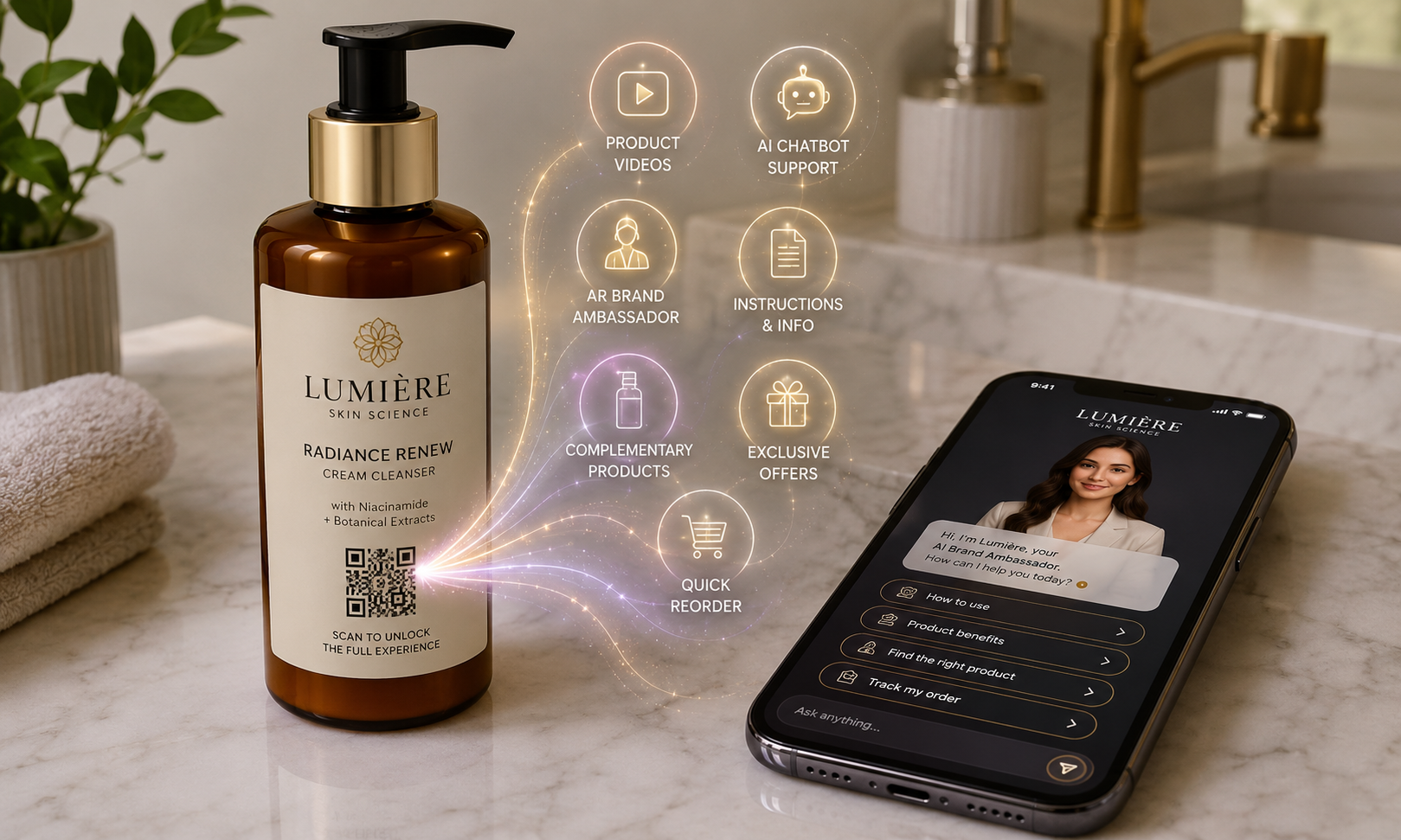
Interactive Product Labels
Campaign Type: Interactive Post-Purchase Product Engagement Campaign
Audience: Existing Customers & Product Users
Delivery Method: Product Labels
Experience Type: AR Brand Ambassador + AI Product Support + Loyalty & Reordering Experience
Technologies: Dynamic QR Codes, Augmented Reality (WebAR), AR Avatar, AI Chatbot, Landing Pages, Geo-Specific Content, Digital Retargeting, Reporting Dashboard
Overview
This Use Case illustrates how Interactive Product Labels could transform ordinary labels into always-on customer engagement tools that continue working long after the initial purchase.
Product labels remain physically attached to, or closely associated with, the product throughout its use. That makes them one of the most persistent brand touchpoints available after the sale.
By integrating a Dynamic QR Code into the label, brands could give customers immediate access to product demonstrations, how-to content, an AI Product Assistant, AR Brand Ambassador experiences, digital instructions, complementary product recommendations, loyalty rewards, and fast reordering options.
Rather than limiting the label to static information, Interactive Product Labels would create a direct digital connection between the customer and the brand.
One quick scan could provide support at the exact moment a customer needs it, while also creating relevant opportunities to upsell, encourage repeat purchase, and extend loyalty.
The product may already have been purchased, but the customer relationship would continue through the label itself.
Campaign Background
Product labels traditionally serve several important purposes. They communicate branding, product information, instructions, ingredients, specifications, warnings, and regulatory content.
However, physical labels are constrained by space.
There is only so much information that can be printed clearly without overwhelming the design or reducing usability. At the same time, customers increasingly expect easy access to richer product information, video guidance, support, recommendations, and digital services.
Interactive Product Labels would help bridge this gap.
Instead of attempting to fit every piece of information onto the physical label, brands could use the label as the gateway to a deeper digital experience.
This would be particularly valuable for products that customers use repeatedly, require explanation, have related accessories or consumables, or naturally create repeat purchase opportunities.
Because the label stays with the product, the engagement opportunity also stays with the customer.
Rather than relying on customers to search for manuals, visit a website, or remember where they purchased the item, Interactive Product Labels would make the next step immediately accessible from the product itself.
Challenge
In this illustrative scenario, launching Interactive Product Labels would aim to:
- Extend customer engagement beyond the initial purchase
- Provide easy access to product education and support
- Deliver richer information without overcrowding the physical label
- Help customers get greater value from the product
- Create relevant upsell and cross-sell opportunities
- Encourage loyalty participation and repeat purchase
- Simplify reordering and replenishment
- Capture measurable insights into post-purchase engagement
Traditional product labels provide essential information, but their role is largely static.
Interactive Product Labels would be designed to transform that static touchpoint into a dynamic customer experience channel.
Solution
The Interactive Product Labels campaign could function in the following way:
Interactive Label Access
Each product label would feature a clearly integrated Dynamic QR Code.
The code would act as the access point to a mobile-optimized digital experience, with no app download required.
The value would not be in the QR code itself, but in the experience that follows the scan.
Product Videos & Demonstrations
Customers could instantly access:
- Product demonstrations
- Setup videos
- How-to guides
- Usage tips
- Maintenance advice
- Troubleshooting content
This would help customers understand how to use the product correctly and confidently.
AR Brand Ambassador
Scanning the Interactive Product Label could launch an AR Brand Ambassador or Virtual Salesperson.
The AR experience could:
- Introduce the product
- Explain key features
- Share the brand story
- Highlight recommended usage
- Suggest complementary products
- Direct customers toward relevant support or offers
This would add a more human and engaging layer to the post-purchase experience.
AI Product Assistant
An integrated AI Chatbot could provide instant support by answering questions such as:
- How do I use this product?
- What does this feature do?
- Which accessory is compatible?
- How should the product be maintained?
- Where can I find replacement parts?
- Can I reorder this product?
This would reduce the need for customers to search through websites or wait for support.
Instructions, Guides & Product Information
Interactive Product Labels could provide direct access to:
- User manuals
- Product specifications
- Safety information
- Care instructions
- Frequently asked questions
- Warranty information
- Registration forms
Because this information would be delivered digitally, it could be kept current without changing the original printed label.
Upsell & Complementary Products
The digital experience could recommend relevant:
- Accessories
- Refills
- Replacement parts
- Product bundles
- Related products
- Premium upgrades
These recommendations would be based on the product already in the customer’s hands, making them contextually relevant rather than generic.
Loyalty Rewards & Exclusive Offers
Interactive Product Labels could also invite customers to:
- Join a loyalty program
- Register their purchase
- Unlock exclusive rewards
- Access members-only offers
- Enter promotions or competitions
- Receive future product benefits
This would create a direct pathway from product ownership to ongoing brand engagement.
Fast Reordering
For products that require replenishment, replacement, or repeat purchase, the experience could provide immediate options to:
- Reorder the same product
- Buy a refill
- Start a subscription
- Purchase a replacement
- Locate a nearby retailer
- Buy online instantly
This would reduce friction and make repeat purchasing more convenient.
Geo-Specific Content
Content could adapt based on the customer’s location.
This could include:
- Local retailer information
- Region-specific offers
- Local product availability
- Market-specific support information
- Area-specific promotions
Geo-Specific Content would help make the experience more relevant to each customer.
Digital Retargeting
Customers who engage with Interactive Product Labels could receive relevant follow-up digital communication aligned with their interests.
This could reinforce:
- Product education
- Accessory recommendations
- Reordering reminders
- Loyalty offers
- Related product promotions
Engagement Reporting
Brands could capture insights including:
- Number of scans
- Most-viewed product content
- AI Chatbot interactions
- Manual and guide access
- Product registrations
- Upsell interest
- Loyalty engagement
- Reorder activity
- Engagement duration
These insights would help marketers better understand what customers need and how they interact with products after purchase.
Why Interactive Product Labels Work
Interactive Product Labels would work because they would transform a touchpoint that already stays close to the customer into an active engagement channel.
Unlike many forms of marketing, product labels remain associated with the product after the sale. That creates repeated opportunities for the customer to scan, engage, and return to useful content over time.
Product videos would help customers use the product effectively. AI Product Assistants would provide instant support. AR Brand Ambassadors would make the experience more engaging and personal. Digital guides would reduce friction, while complementary product recommendations and reordering pathways would create natural opportunities for additional sales.
The interaction would also happen in context.
The customer would not be receiving a random promotion. They would be engaging from a product they already own, making support, upsell, and loyalty opportunities more relevant.
Rather than treating the label as the final piece of product communication, Interactive Product Labels would turn it into the beginning of an ongoing brand relationship.
Conclusion
Interactive Product Labels would represent a meaningful evolution in post-purchase marketing and customer experience.
By integrating Dynamic QR Codes, AR Brand Ambassadors, AI-powered support, digital guides, loyalty rewards, upsell opportunities, and fast reordering into product labels, brands could extend customer engagement well beyond the point of sale.
For customers, the experience would provide immediate access to useful content, support, and product information whenever it is needed.
For brands, it would create more opportunities to strengthen relationships, encourage loyalty, increase upsell and repeat purchases, and gain valuable insight into post-purchase behaviour.
The product may have been purchased.
With Interactive Product Labels, the brand experience would not have to end there.
Contact Us if you’d like to learn more about implementing Interactive Product Labels into your business.