
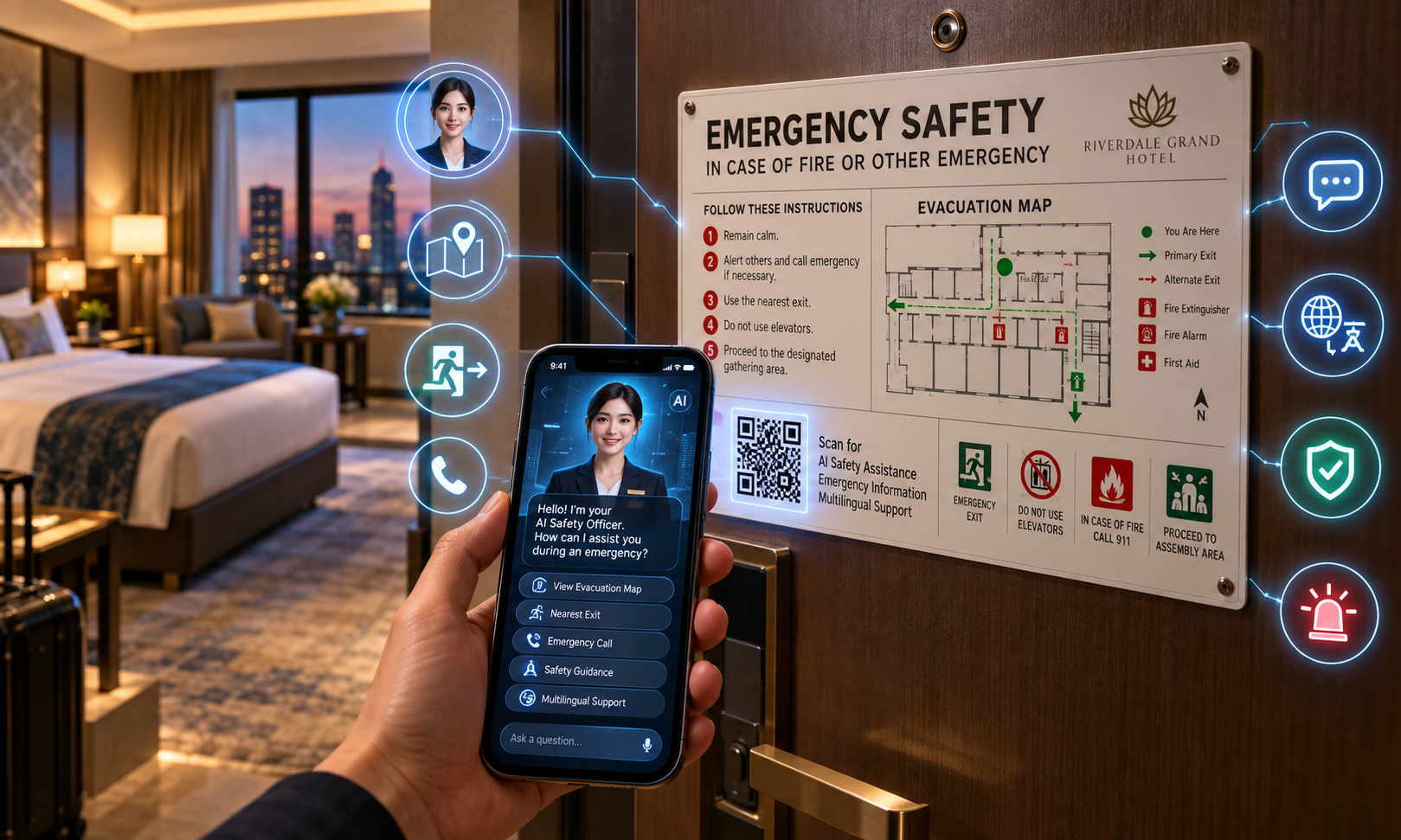
AI-Enhanced Safety signage (Hospitality)
Campaign Type: AI-Enhanced Emergency Information & Guest Safety Experience
Audience: Hotel & Resort Guests
Delivery Method: Safety signage & In-Room Emergency Information
Experience Type: AI Safety Officer + Location-Specific Evacuation Guidance + Multilingual Emergency Support
Technologies: Dynamic QR Codes, Augmented Reality (WebAR), AR Avatar, AI Chatbot, Interactive Maps, Geo-Specific Content, Multilingual Content, Integrated Messaging, Reporting Dashboard
Overview
This Use Case illustrates how AI-Enhanced Safety signage could add an interactive digital layer to mandatory emergency information within hotels, resorts, and other accommodation facilities.
During an emergency, guests may be in an unfamiliar building, uncertain about the nearest safe exit, unable to easily interpret a traditional evacuation diagram, or unable to understand instructions presented in the local language.
AI-Enhanced Safety signage could provide an additional source of guidance.
A QR Code positioned alongside the mandatory emergency information within each guest room could launch a location-specific digital response experience directly from the guest’s smartphone.
The experience could provide guidance from an AI Safety Officer Avatar, display an interactive evacuation map relevant to that room, identify primary and alternative emergency exits, provide emergency telephone numbers, offer approved AI Chatbot assistance, allow guests to select their preferred language, provide a pathway to request assistance or confirm their status, and display important emergency updates where supported by the property’s emergency systems.
Importantly, the interactive experience would not replace mandatory printed signage, emergency alarms, illuminated exit signs, instructions from emergency personnel, or established evacuation procedures.
That essential information would remain immediately visible and available without requiring a smartphone, internet connection, or QR Code scan.
AI-Enhanced Safety signage would provide an additional layer of support designed to help guests understand the information available and act upon it.
Campaign Background
Hotels and resorts accommodate guests who may have little or no familiarity with the property.
A guest may know how to travel between their room, lobby, restaurant, pool, or other facilities during normal circumstances, but an emergency creates an entirely different environment.
They may need to identify an emergency exit they have never used, navigate an unfamiliar corridor or stairwell, understand evacuation instructions quickly, or determine how to request assistance.
International guests may face an additional challenge if emergency information is not presented in a language they understand confidently.
Traditional safety signage plays an essential role in communicating evacuation routes, emergency exits, assembly information, and other safety instructions.
However, physical signage has practical limitations.
The available space is finite. Information is largely static. Providing extensive multilingual instructions can make signs more difficult to interpret. A standard evacuation diagram may also require a guest to translate a two-dimensional plan into an understanding of where they physically need to go.
AI-Enhanced Safety signage could complement this essential printed information with a digital experience specific to the guest’s location.
The physical sign would provide immediate mandatory information.
The interactive layer could provide additional explanation, navigation, language options, and support.
Challenge
In this illustrative scenario, introducing AI-Enhanced Safety signage would aim to:
- Help guests understand emergency information more easily
- Provide additional location-specific evacuation guidance
- Help identify primary and alternative emergency exits
- Make emergency information available in multiple languages
- Provide immediate access to important emergency contact information
- Give guests an additional pathway to request assistance
- Help communicate approved emergency updates and instructions
- Support guests who may be unfamiliar with the property
- Provide additional digital guidance without replacing mandatory physical safety information
The objective would not be to redesign established emergency procedures around a digital experience.
It would be to make existing emergency information easier to understand and act upon.
Solution
The AI-Enhanced Safety signage experience could function in the following way:
Location-Specific Emergency Access
A Dynamic QR Code could be incorporated alongside safety signage positioned within each guest room.
Each QR Code could be associated with the specific room or location in which the sign was installed.
When scanned, the guest would therefore access information relevant to that location rather than being directed to a generic emergency webpage.
This could allow the experience to immediately present the appropriate evacuation information, relevant exits, emergency contacts, and other approved instructions.
No app download would be required.
AI Safety Officer Avatar
The experience could feature an AI Safety Officer Avatar designed to communicate approved emergency guidance in a clear and structured manner.
The Avatar could:
- Explain the emergency information presented
- Direct attention to the evacuation map
- Identify relevant evacuation instructions
- Explain how to access emergency assistance
- Present approved safety information
- Guide the guest toward relevant resources
The objective would be to make emergency information easier to understand, not to allow AI to independently determine emergency procedures.
The AI Safety Officer would operate within approved information and established safety protocols defined by the property.
Interactive Evacuation Map
A guest could access an interactive evacuation map specific to their room or current location.
The map could clearly identify:
- The guest’s starting location
- Primary emergency exit routes
- Alternative emergency exits
- Emergency stairwells
- Relevant assembly points
- Other approved emergency facilities
Rather than requiring the guest to interpret a generic building map alone, the interactive experience could provide greater context around where they are and the approved routes available from that location.
Primary & Alternative Emergency Exits
AI-Enhanced Safety signage could make approved exit information easier to identify.
The experience could highlight the primary evacuation route associated with the location while also displaying approved alternative routes where appropriate.
Any guidance would remain subordinate to actual emergency conditions, illuminated exit signage, alarms, directions from emergency personnel, and the property’s established emergency procedures.
The interactive experience would support those systems rather than override them.
Emergency Contact Information
Guests could immediately access relevant emergency telephone numbers and contact pathways.
Depending on the property and emergency plan, this could include:
- Emergency services
- Hotel reception
- Property security
- Emergency response personnel
- Other designated assistance contacts
One-tap calling could reduce the need for a guest to search for telephone numbers during a stressful situation.
AI Chatbot Assistance
An integrated AI Chatbot could provide answers to approved emergency and safety questions.
Guests might ask:
- Where is my nearest emergency exit?
- Where is the assembly point?
- How do I contact reception?
- Where is the emergency stairwell?
- What does this instruction mean?
The AI Chatbot would need to operate within a tightly controlled knowledge base containing approved property-specific emergency information.
It would not replace instructions from emergency services, alarms, emergency personnel, or official safety procedures.
Where a question could not be safely or reliably answered, the experience could direct the guest toward the appropriate emergency contact or established instruction.
Multilingual Emergency Information
One of the most valuable capabilities of the digital experience could be multilingual access.
Guests could select their preferred language and access approved emergency information in a form they could more readily understand.
This could include:
- Safety instructions
- Evacuation guidance
- AI Safety Officer content
- Interactive map information
- Emergency contact information
- Approved AI Chatbot responses
This would allow hotels and resorts serving international guests to provide greater language accessibility without attempting to place every possible language on the physical emergency sign.
Assistance & Safety Status
Where supported by the property’s emergency response infrastructure, the experience could provide guests with a simple pathway to:
- Request assistance
- Indicate that assistance may be required
- Confirm they have reached a designated safe location
- Access appropriate emergency contacts
This information could potentially assist authorized property personnel with understanding guest status during an emergency.
Any such capability would require appropriate operational procedures, system integration, privacy controls, and clearly defined responsibilities to ensure it complemented rather than complicated established emergency response processes.
Emergency Updates
Where appropriate system integration was available, the experience could provide approved emergency updates.
These could include information such as:
- Updated instructions
- Assembly information
- Property-specific announcements
- Relevant emergency contact information
- Other approved safety communications
This would give the property an additional communication channel while established emergency systems remained the primary source of emergency alerts and instructions.
Dynamic Content
Because the QR Code would connect to a digital experience, approved supporting content could be updated without replacing the physical sign.
This could be useful where:
- Emergency contact information changes
- Property layouts are modified
- Procedures are updated
- Language options are expanded
- Supporting information changes
The mandatory physical safety signage itself would continue to be maintained and updated in accordance with applicable requirements.
Engagement & System Reporting
Where appropriate, the platform could provide non-sensitive operational insight into use of the digital experience.
This could include:
- Number of scans
- Locations generating scans
- Language selections
- Information accessed
- Assistance pathways selected
- Engagement with emergency contact options
- AI Chatbot usage
For normal testing and preparedness, these insights could help property operators understand how the interactive experience is being used and identify opportunities to improve supporting digital information.
Any emergency response functionality involving identifiable guest information would require appropriate privacy, security, operational, and regulatory controls.
Why AI-Enhanced Safety signage Works
AI-Enhanced Safety signage would work because it would add additional support to an essential physical touchpoint already positioned where guests can access it.
The mandatory emergency sign would remain immediately visible.
The interactive experience would simply provide another layer of assistance for guests who need it.
This could be particularly valuable in hotels and resorts because guests are, by definition, temporary occupants. They may have arrived only hours earlier and have limited knowledge of the building layout.
An interactive map could make evacuation information easier to interpret. Location-specific content could immediately orient the guest to their starting point. Multilingual information could help overcome language barriers. An AI Safety Officer could explain approved instructions, while an appropriately controlled AI Chatbot could help guests find relevant information quickly.
The experience could also provide immediate access to emergency contacts and, where properly integrated with hotel systems and procedures, additional pathways to request assistance or receive approved updates.
Importantly, none of these capabilities would diminish the role of traditional safety signage.
Physical signs, alarms, exit indicators, emergency lighting, evacuation procedures, and trained personnel would remain fundamental.
Interactive Print would add another layer.
In an emergency, providing information is important.
Helping people understand that information and act on it could be even more valuable.
Conclusion
AI-Enhanced Safety signage would represent a potentially valuable evolution in how hotels and resorts support guests with emergency information.
By combining mandatory physical signage with Dynamic QR Codes, location-specific interactive maps, an AI Safety Officer Avatar, controlled AI Chatbot support, multilingual information, emergency contacts, and approved digital updates, accommodation providers could provide guests with an additional layer of guidance when they may need it most.
For guests, the experience could make emergency information easier to understand, more relevant to their location, and more accessible in their preferred language.
For hotel and resort operators, it could provide an opportunity to complement existing safety procedures with an additional digital support channel designed around the needs of guests unfamiliar with the property.
The physical emergency sign would remain essential.
The technology would not replace it.
A standard emergency sign provides information.
AI-Enhanced Safety signage could help people understand it and act on it.
Contact Us if you’d like to learn more about implementing AI-Enhanced Safety Signage into your business.