
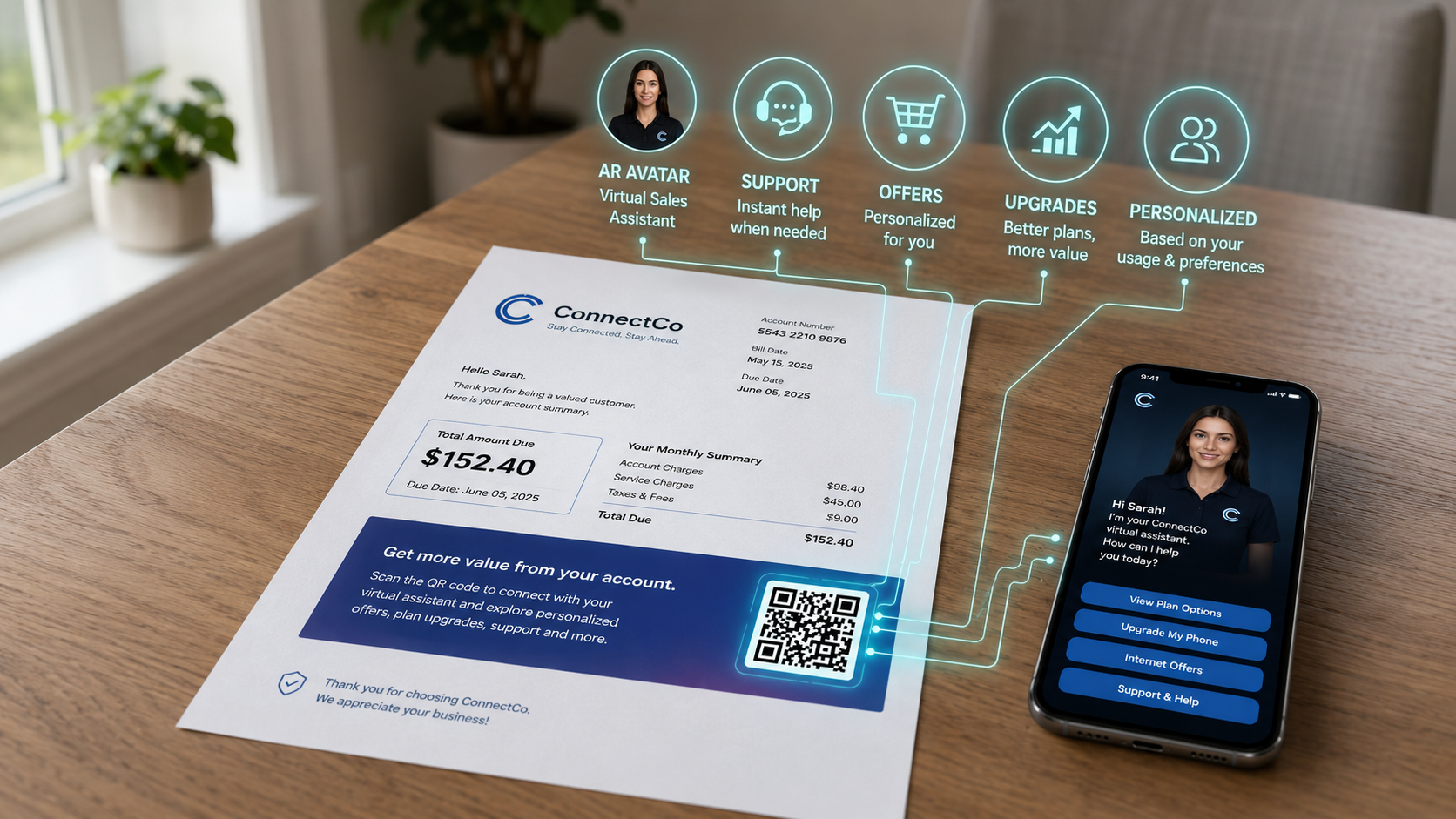
Interactive Transactional Mail
Campaign Type: Interactive Transactional Mail Customer Engagement Campaign
Audience: Existing Customers & Account Holders
Delivery Method: Transactional Mail (Bills, Statements & Account Notices)
Experience Type: AR Avatar Messaging + Personalized Offers + AI Customer Support
Technologies: Augmented Reality (WebAR), Personalized QR Codes, Personalized Landing Pages, AI Chatbot, Geo-Specific Content, Integrated Email, Digital Retargeting, Reporting Dashboard
Overview
This Use Case illustrates how Interactive Transactional Mail could transform routine customer communications into powerful engagement, retention, and upsell opportunities.
Instead of functioning solely as static bills or statements, Interactive Transactional Mail pieces would become personalized digital gateways that connect customers to tailored support, offers, and self-service experiences. By embedding Personalized QR Codes directly into printed communications, customers would be able to scan and instantly access interactive experiences designed specifically for them.
One scan could launch an AR Avatar delivering a personalized message, present recommended upgrades based on account activity, connect customers to AI-powered support, or provide personalized self-service pathways. Rather than ending at the printed statement, the customer journey would continue into an immersive digital experience designed to inform, support, and engage.
This approach would transform mandatory customer communications into meaningful interaction opportunities — helping organizations increase relevance while improving customer experience.
Campaign Background
Transactional mail remains one of the most consistently opened forms of customer communication. Bills, account statements, renewal notices, and service summaries are expected and routinely reviewed by customers across industries such as telecommunications, utilities, finance, insurance, and subscription services.
However, most transactional mail pieces remain highly static. They communicate charges, balances, or account activity but often fail to create additional value beyond the transaction itself.
At the same time, organizations seek more effective ways to strengthen customer retention, encourage product adoption, improve support accessibility, and create more personalized engagement journeys.
Interactive Transactional Mail would address this challenge by transforming routine communications into interactive customer experience platforms. Instead of serving only as informational documents, bills and statements would become personalized engagement tools capable of supporting education, upselling, and customer support directly from the printed piece.
This evolution would allow organizations to maximize the value of communications customers are already expecting to receive.
Challenge
In this illustrative scenario, launching an Interactive Transactional Mail campaign would aim to:
- Increase engagement with transactional communications
• Deliver relevant upgrade and retention opportunities
• Simplify customer support access
• Provide personalized experiences based on customer behavior
• Capture measurable interaction insights from printed communications
Traditional transactional mail is highly visible but limited in engagement capability. Interactive Transactional Mail would be designed to bridge this gap by combining print credibility with digital personalization and interactivity.
Solution
The Interactive Transactional Mail campaign could function in the following way:
Personalized Transactional Mail
Each bill or statement would feature a Personalized QR Code unique to the customer. This code would serve as the gateway to a customized interactive experience.
AR Avatar Messaging
Scanning the QR Code could launch an AR Avatar who explains important account information in a conversational format.
The Avatar could:
- Summarize account activity
• Explain billing changes
• Highlight upgrade opportunities
• Introduce new services
• Recommend relevant products or plans
This would create a more human and engaging customer interaction experience.
Personalized Landing Pages
The experience could direct customers to Personalized Landing Pages containing:
- Account-specific recommendations
• Device upgrade opportunities
• Plan optimization suggestions
• Loyalty rewards or promotions
• Personalized offers aligned with usage behavior
This dynamic content would ensure relevance for each individual customer.
AI-Powered Customer Support
Customers could connect directly to an AI Chatbot capable of:
- Answering billing questions
• Explaining charges or account changes
• Assisting with service requests
• Recommending products or services
• Providing self-service support pathways
This would reduce friction and improve accessibility to support resources.
Geo-Specific Content
Content could dynamically adapt based on customer location, allowing organizations to promote:
- Regional offers
• Local service availability
• Area-specific promotions
• Infrastructure or service updates
Geo-Specific Content would increase relevance and personalization.
Integrated Email Follow-Up
Customers who engage with the Interactive Transactional Mail experience could receive synchronized email communication aligned with their interests and interaction behavior.
This would create continuity between print and digital engagement channels.
Digital Retargeting
Recipients who interact with Personalized QR Codes could be included in digital retargeting audiences for continued engagement and offer reinforcement.
Engagement Reporting
Interaction data such as scan activity, content engagement, chatbot interactions, and offer clicks could be tracked through a Reporting Dashboard. These insights would help optimize future customer communication strategies.
Why Interactive Transactional Mail Works
Interactive Transactional Mail would combine the reliability and visibility of printed customer communications with the immediacy and personalization of digital engagement.
Transactional mail already captures customer attention because it contains relevant account information. By layering Personalized QR Codes, AR Avatar experiences, AI-powered support, and personalized Landing Pages onto those communications, organizations would create significantly richer engagement opportunities without increasing communication frequency.
AR Avatars would humanize account communication. AI Chatbots would simplify support access. Personalized recommendations would improve relevance, while Digital Retargeting would extend engagement beyond the initial interaction.
Rather than functioning as static administrative documents, Interactive Transactional Mail pieces would become interactive customer experience platforms capable of informing, supporting, retaining, and upselling simultaneously.
Conclusion
Interactive Transactional Mail would represent a meaningful evolution in customer communication strategy. By integrating Personalized QR Codes, AR Avatar experiences, AI-powered support, and dynamic personalized content into routine bills and statements, organizations could transform expected communications into interactive engagement opportunities.
Instead of delivering static transactional information alone, Interactive Transactional Mail would create personalized customer journeys that support retention, self-service, product discovery, and ongoing engagement directly from the printed piece.
In modern customer communication environments, Interactive Transactional Mail would not simply enhance traditional statements and bills. It would become the new standard for transforming transactional communications into interactive, personalized customer engagement experiences.
Contact Us if you’d like to learn more about implementing Interactive Transactional Mail into your marketing.