
Interactive Travel Mail
Campaign Type: Interactive Travel Mail Campaign
Audience: Prospective Travelers, Holiday Planners & Existing Customers
Delivery Method: Direct Mail
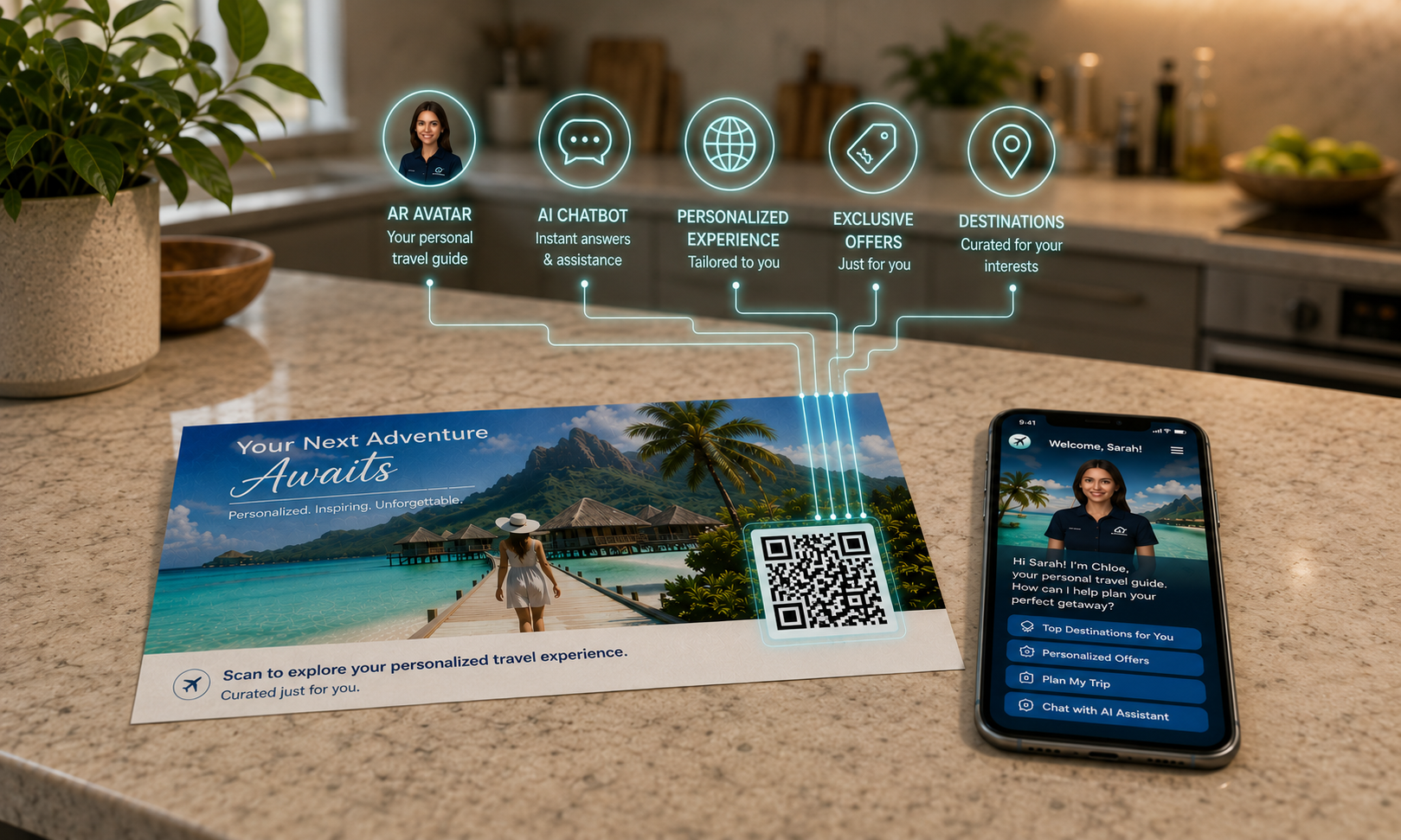
Experience Type: AR Travel Guide + Personalized Destination Experiences + AI Travel Assistant
Technologies: Augmented Reality (WebAR), Dynamic QR Codes, AR Avatars, AI Chatbot, Personalized Landing Pages, Geo-Specific Content, Digital Retargeting, Reporting Dashboard
Overview
This Use Case illustrates how Interactive Travel Mail could transform traditional travel marketing from a static promotional piece into an engaging, personalized customer experience.
For many travel brands, the QR code has become the centerpiece of print and mail campaigns. However, the QR code itself has little value. It is simply a gateway. The real opportunity lies in what happens after the scan.
Interactive Travel Mail would shift the focus away from the QR code and onto the customer experience. Rather than directing recipients to a generic webpage, a single scan could launch an immersive digital journey featuring AR Avatars, AI-powered assistance, personalized destination recommendations, and interactive travel content.
Instead of asking potential travelers to imagine the experience, Interactive Travel Mail would allow them to explore it. From virtual destination previews to personalized holiday packages and instant travel assistance, every interaction would be designed to inform, inspire, and guide customers toward booking decisions.
This approach would combine the attention-grabbing power of Direct Mail with the engagement and personalization of modern digital experiences.
Campaign Background
Travel marketing has always relied heavily on inspiration. Beautiful imagery, compelling destinations, and aspirational experiences play a critical role in attracting customer interest.
Traditional travel brochures and mail pieces can be highly effective at creating awareness, but they often struggle to provide the depth of engagement modern consumers expect. Many campaigns direct recipients to generic websites where the personalized experience immediately disappears.
At the same time, travelers increasingly expect convenience, personalization, and immediate access to information. They want answers quickly, recommendations tailored to their interests, and booking pathways that feel relevant to their needs.
Interactive Travel Mail would address these expectations by transforming Direct Mail into an interactive customer experience platform. Instead of acting as a static promotional piece, the mailer would become the entry point into a personalized travel journey.
This evolution would allow travel brands to move beyond simple awareness and create meaningful engagement from the very first interaction.
Challenge
In this illustrative scenario, launching an Interactive Travel Mail campaign would aim to:
- Create memorable travel experiences directly from Direct Mail
• Deliver personalized content rather than generic destination pages
• Inspire travelers through immersive and interactive storytelling
• Simplify access to travel information and booking pathways
• Capture meaningful engagement insights beyond scan activity
Traditional travel mailers often focus on generating scans. Interactive Travel Mail would focus on creating experiences that motivate customers to continue engaging long after the initial interaction.
Solution
The Interactive Travel Mail campaign could function in the following way:
Interactive Direct Mail Piece
Each travel mailer would feature a Dynamic QR Code integrated naturally into the design. Rather than promoting the QR code itself, the campaign would focus on the experience waiting behind it.
AR Travel Guide
Scanning the mail piece could launch an AR Avatar acting as a virtual travel guide.
The AR experience could:
- Introduce featured destinations
• Highlight package inclusions
• Explain seasonal travel opportunities
• Showcase local attractions
• Provide travel tips and recommendations
This would create a more engaging and humanized experience than traditional brochures alone.
Personalized Landing Pages
The experience could direct recipients to Landing Pages tailored to their interests and preferences.
Content could include:
- Recommended destinations
• Family, luxury, adventure, or cruise packages
• Travel offers aligned with previous interests
• Personalized itineraries and suggestions
This would ensure relevance from the very first interaction.
AI Travel Assistant
An integrated AI Chatbot could provide instant support by:
- Answering travel questions
• Recommending destinations
• Explaining package details
• Assisting with booking inquiries
• Providing travel planning guidance
This would allow customers to receive immediate assistance without leaving the experience.
Immersive Destination Content
Interactive Travel Mail could include:
- 360-degree destination experiences
• Video tours
• AR-enhanced destination previews
• Resort and accommodation showcases
• Interactive itinerary exploration
These experiences would help travelers visualize their journey before making a decision.
Geo-Specific Content
Content could dynamically adapt based on location, promoting:
- Nearby departure points
• Regional travel offers
• Local events and travel opportunities
• Destination recommendations aligned with market demand
Geo-Specific Content would increase relevance and personalization.
Digital Retargeting
Recipients who engage with Interactive Travel Mail could receive follow-up digital communication aligned with destinations, offers, and content they explored.
This would help maintain engagement beyond the initial scan.
Engagement Reporting
Interaction data such as destination views, content engagement, chatbot conversations, and offer interactions could be tracked through a Reporting Dashboard. These insights would help optimize future travel campaigns and customer experiences.
Why Interactive Travel Mail Works
Interactive Travel Mail would focus on the part of the customer journey that matters most — the experience after the scan.
Too many print campaigns place all their emphasis on the QR code itself. Yet consumers rarely remember how they arrived at an experience. They remember the experience they had.
By combining Direct Mail with AR Avatars, AI-powered assistance, immersive destination content, and personalized Landing Pages, Interactive Travel Mail would create richer, more memorable interactions.
The AR Travel Guide would provide engagement. Personalized content would create relevance. AI assistance would remove friction. Digital Retargeting would extend the relationship beyond the mail piece.
Rather than functioning as a simple promotional mailer, Interactive Travel Mail would become a personalized travel discovery platform — one capable of inspiring, educating, and guiding customers toward booking decisions.
Conclusion
Interactive Travel Mail would represent a meaningful evolution in travel marketing. By transforming traditional Direct Mail into an immersive, personalized customer experience, travel brands could create deeper engagement and stronger connections with prospective travelers.
Instead of focusing on the QR code itself, Interactive Travel Mail would focus on the experience behind it — delivering AR-powered storytelling, AI-driven assistance, and personalized travel inspiration from a single scan.
In modern travel marketing, Interactive Travel Mail would not simply enhance Direct Mail campaigns. It would become the new standard for creating engaging, interactive, and memorable customer experiences that continue well beyond the mailbox.
Contact Us if you’d like to learn more about implementing Interactive Travel Mail into your marketing.