
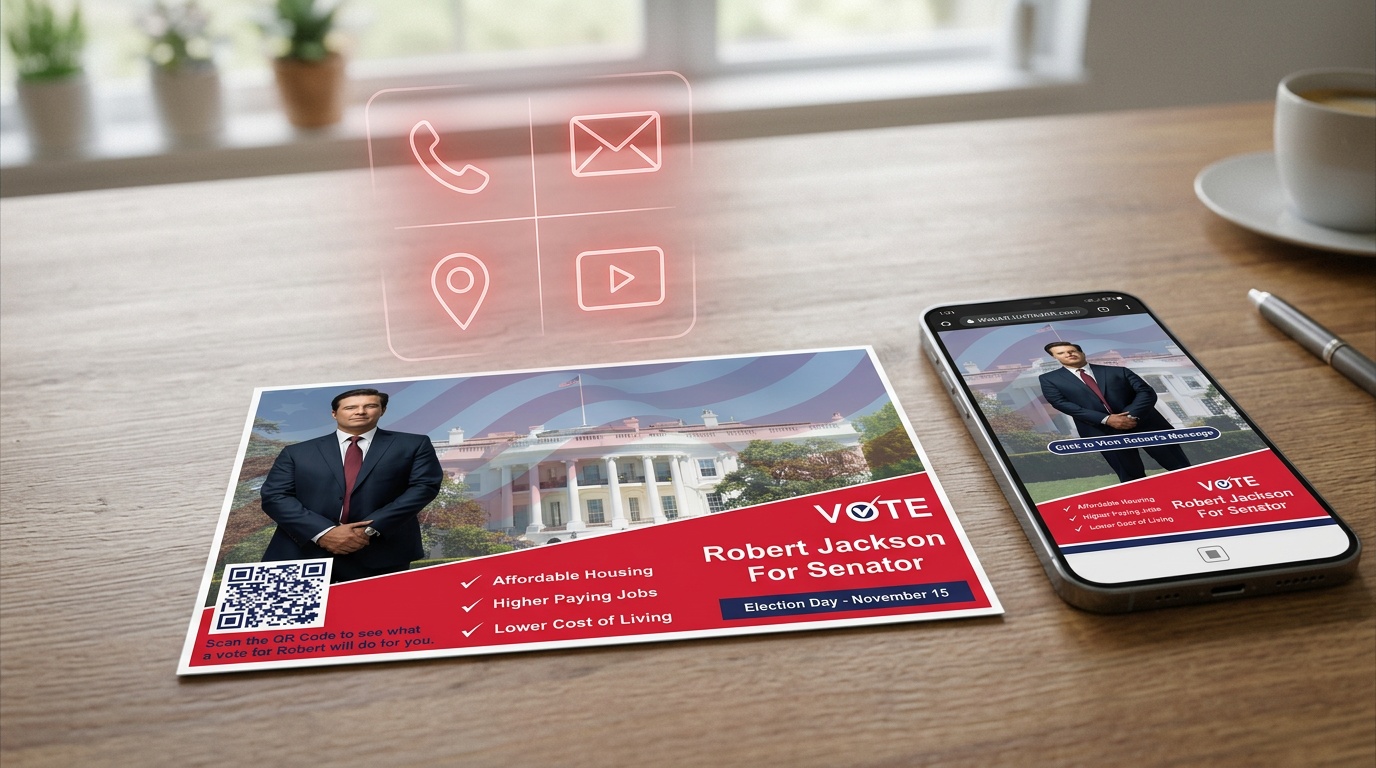
AR-Enabled Political Campaigning
Campaign Type: AR-Enabled Policy Communication
Audience: Registered Voters in Target Districts
Delivery Method: Mail
Experience Type: AR Avatar Policy Presentation + Localised Impact Stories
Technologies: Augmented Reality (WebAR), Dynamic QR Codes, Dynamic Landing Pages, Geo-Specific Content
Overview
This Use Case illustrates how Direct Mail could be enhanced with Augmented Reality to transform political campaigning and policy communication into a clearer, more engaging, and more accessible experience for voters. By combining print with AR Avatar technology, complex policy topics could be explained in plain language, supported by localised examples that help recipients understand how policies may apply to their own communities.
Rather than relying solely on dense text, this approach would allow policy messages to be delivered in a more human, conversational format – helping voters engage with information at their own pace and on their own terms.
Customer & Campaign Background
Political campaigning and civic communications often rely on printed mail to reach broad audiences. While effective for distribution, traditional mailers can struggle to communicate complex policy ideas in a way that feels relevant or easy to digest.
This example demonstrates how Interactive Direct Mail could be used to modernize policy education. By pairing printed communication with AR-enabled experiences, policy messages could be presented visually and verbally, making them more approachable while maintaining the credibility and reach of print.
Challenge
In this scenario, the campaign would need to address several common challenges:
- Explaining complex policy topics in a way that is easy to understand
- Making policy information feel relevant to local communities
- Increasing engagement with mailed communications
- Providing clear pathways for voters to learn more or participate
- Gaining insight into how audiences engage with policy content
Solution
The campaign could be delivered in the following way:
- AR-Enabled Mailer: Each Direct Mail piece would feature a clear, scannable Dynamic QR Code.
- AR Avatar Policy Presentation: Scanning the QR Code would launch an AR Avatar delivering a concise policy explanation in plain language.
- Geo-Specific Content: The AR experience could dynamically display examples or scenarios relevant to the recipient’s local area.
- Interactive Options: From within the experience, recipients could be invited to explore additional information, submit questions, or register interest in future updates.
- Landing Pages: Follow-on Landing Pages could provide deeper policy detail, supporting documents, or related announcements.
- Engagement Reporting: Interaction data could be captured to help inform future communication strategies.
Why AR-Enabled Political Campaigning Works
This approach would allow policy communication to move beyond static text and into a more engaging, conversational format that encourages exploration rather than passive reading. AR Avatars could present information in clear, plain language, guiding audiences through complex topics step by step and helping to humanize policies that are often perceived as distant or abstract. Geo-specific examples could further enhance relevance by showing how decisions and initiatives apply at a local or community level, making information feel timely and meaningful.
By combining print’s credibility and broad reach with digital interactivity, this method would create a balanced communication channel that enhances understanding, improves accessibility, and increases engagement -while still respecting and preserving the role of traditional print formats.
Conclusion
AR-Enabled Political Campaigning delivered via Direct Mail demonstrates how Interactive Print could be used to improve public understanding and engagement with complex policy information. By blending familiar print formats with Augmented Reality and digital touchpoints, campaigns could move beyond slogans to provide layered, explorable content – such as short explainer videos, issue summaries, FAQs, and candidate messages – accessible instantly from a single scan. This approach allows audiences to engage at their own pace, revisit information, and explore topics most relevant to them, reducing confusion and misinformation.
In the evolving landscape of Political Campaigning, Interactive Print would no longer be viewed as an experimental add-on. Instead, it would represent a practical, scalable, and modern standard for delivering clearer, more transparent political communications that foster trust, understanding, and more informed civic participation.
Contact Us if you’d like to learn more about implementing AR-Enabled Political Campaigning into your marketing.