
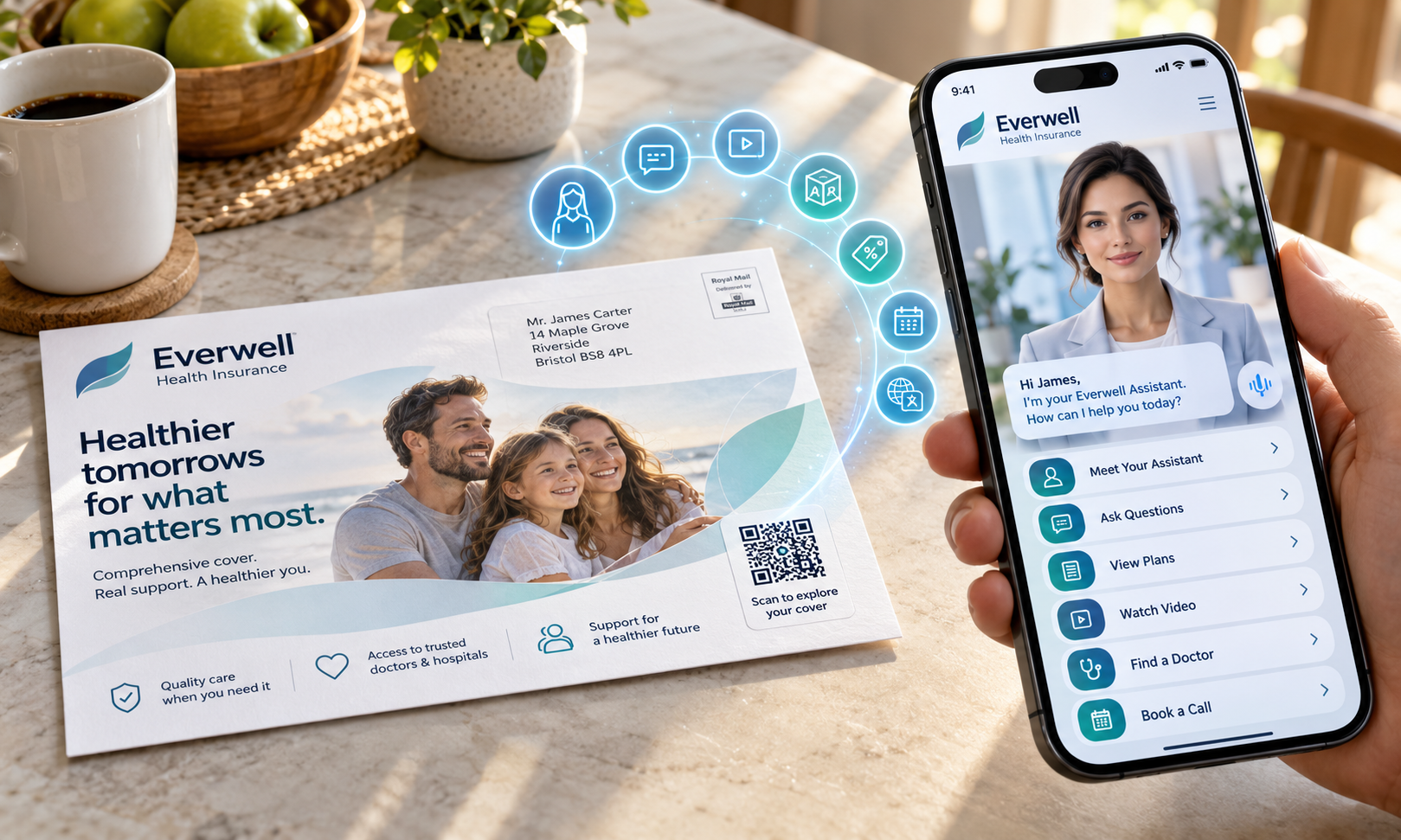
AI-Enhanced Postcards (Healthcare Insurance)
Campaign Type: AI-Enhanced Customer Acquisition & Engagement Campaign
Audience: Prospective Private Healthcare Insurance Customers
Delivery Method: Direct Mail Postcard
Experience Type: AI Digital Twin + AI Insurance Assistant + Personalized Customer Journey
Technologies: Personalized QR Codes, Personalized Landing Pages, Augmented Reality (WebAR), AR Avatar, AI Chatbot, Interactive Video, Geo-Specific Content, Multilingual Content, Digital Retargeting, Reporting Dashboard
Overview
This Use Case illustrates how AI-Enhanced Postcards could transform a traditional private healthcare insurance postcard into an intelligent, interactive, and personalized customer experience.
Postcards provide marketers with an immediate advantage. There is no envelope to open. The message, brand, offer, and call-to-action can be placed directly in front of the recipient.
But the physical postcard can only communicate so much.
By incorporating a Personalized QR Code, an AI-Enhanced Postcard could give recipients immediate access to a much richer experience directly from their smartphone.
A prospective healthcare insurance customer could meet an AI-powered Digital Twin, ask general questions through an AI Chatbot, watch explanatory video content, explore available products and benefits, receive personalized information and offers, access content in their preferred language, and move directly toward requesting a quote, speaking with a representative, or taking another relevant action.
The postcard would continue doing what print does well: capturing attention and placing a tangible message directly into the recipient’s hands.
AI and Interactive Print would then give the recipient somewhere meaningful to go next.
Because a QR Code alone does not create an experience.
What happens after the scan does.
Campaign Background
Private healthcare insurance can involve a significant amount of information.
Prospective customers may want to understand available products, levels of cover, benefits, eligibility, waiting periods, provider information, pricing options, and other factors before deciding whether to take the next step.
A postcard can be highly effective at introducing the proposition, communicating a key benefit, and generating initial interest.
However, trying to communicate every relevant detail within a limited amount of physical space could make the printed piece difficult to navigate and reduce the impact of the primary message.
AI-Enhanced Postcards would provide a different approach.
The physical postcard could remain simple, visually engaging, and focused on generating interest.
The interactive experience behind the scan could then provide the depth.
Rather than asking recipients to independently search through a website or navigate multiple pages, the postcard could connect them directly with an experience designed around the campaign.
The recipient could explore the information they want, ask questions, view relevant content, and take action from the same experience.
This would allow the postcard to become more than a promotional message.
It could become the starting point for an interactive customer journey.
Challenge
In this illustrative scenario, launching AI-Enhanced Postcards would aim to:
- Increase engagement with a Direct Mail campaign
- Extend the amount of information available beyond the physical postcard
- Personalize the experience for individual recipients
- Help prospective customers understand available healthcare insurance options
- Provide immediate answers to common general questions
- Make complex information easier to explore
- Support multilingual customer engagement
- Provide direct pathways to request a quote, enquire, or respond
- Create opportunities for relevant follow-up engagement
- Generate measurable insight into recipient interests and actions
The objective would not be to replace the postcard with a digital experience.
It would be to combine the strengths of both.
Solution
The AI-Enhanced Postcards campaign could function in the following way:
Personalized Direct Mail Postcard
Each recipient could receive a professionally designed postcard featuring a Personalized QR Code unique to them.
Available mailing-list data could be used to personalize elements of the physical postcard, such as:
- Recipient name
- Relevant campaign messaging
- Appropriate offers
- Geographic information
- Other approved customer or prospect data
The printed piece could focus on a clear proposition and call-to-action rather than attempting to communicate every detail.
Scanning the Personalized QR Code would then take the recipient directly into the next stage of the experience.
Personalized Digital Experience
Because each Personalized QR Code could be associated with a unique recipient ID, the experience could recognize which recipient had scanned.
Available campaign data could then be used to tailor written content or determine which information was presented.
The experience could include:
- A personalized greeting
- Relevant healthcare insurance information
- Appropriate products or cover options
- Campaign-specific offers
- Relevant educational content
- Clear next steps
Rather than sending every recipient to the same generic webpage, the postcard could connect them with a more relevant customer journey.
AI-Powered Digital Twin
An AI-powered Digital Twin could create a more engaging introduction to the healthcare insurance provider and campaign.
Appearing through Augmented Reality, the Digital Twin could:
- Welcome the recipient
- Introduce the healthcare provider
- Explain the purpose of the campaign
- Highlight relevant products or benefits
- Introduce important considerations
- Direct recipients toward additional information
- Encourage an appropriate next action
The experience would provide a more human layer to the Direct Mail campaign while remaining accessible whenever the recipient chose to engage.
AI Chatbot
An integrated AI Chatbot could allow prospective customers to ask general questions conversationally.
Depending on the approved information available to the experience, questions could include:
- What types of cover are available?
- What is included with this product?
- Are there waiting periods?
- What additional benefits are available?
- How can I request a quote?
- How can I compare available options?
- How do I speak with someone?
The AI Chatbot could be grounded in approved product and organizational information.
It would be designed to provide general product and campaign information rather than medical advice or individualized health recommendations.
Where a question required personal advice, sensitive information, or specialist assistance, the recipient could be directed toward an appropriate secure or human-assisted channel.
Interactive Video Content
Healthcare insurance information can sometimes be difficult to communicate within the limited space available on a postcard.
Interactive video could help explain topics such as:
- Available cover options
- Product benefits
- How the insurance works
- Member services
- Joining processes
- Frequently asked questions
- Customer support options
This would allow recipients to choose how deeply they wanted to explore the proposition.
Interactive Product Information
Recipients could explore available healthcare insurance products and information from within the experience.
Content could be structured around relevant categories, allowing prospective customers to navigate toward the information most important to them.
Depending on the campaign, this could include:
- Types of cover
- Product features
- Membership benefits
- Additional services
- Provider information
- Frequently requested resources
- Relevant offers
The postcard would therefore provide access to significantly more information than could practically be presented in print alone.
Personalized Content & Offers
Where appropriate data was available, different recipients could receive different content after scanning.
For example, the digital experience could vary according to:
- Campaign segment
- Geographic location
- Existing customer or prospect status
- Known interests
- Offer eligibility
- Other approved campaign data
This would allow the physical campaign to feel considerably more relevant without requiring every piece of information to be printed on the postcard itself.
Multilingual Content
Recipients could also be given the option to access approved campaign and product information in their preferred language.
This could include:
- Digital Twin content
- General product information
- AI Chatbot assistance
- Video content
- Instructions and next steps
This would allow a single physical campaign to support a more diverse audience while keeping the printed design clear and uncluttered.
Immediate Response Pathways
Once a recipient was ready to take the next step, the experience could provide clear pathways to:
- Request a quote
- Explore available products
- Register interest
- Book an appointment or consultation
- Request a callback
- Call customer service
- Visit an appropriate application or enquiry page
The objective would be to reduce the number of steps between initial interest and action.
Geo-Specific Content
Where relevant, Geo-Specific Content could help present information appropriate to the recipient’s location.
This could support:
- Location-relevant products or services
- Regional contact information
- Appropriate offers
- Nearby service information
- Other geographically relevant content
A default experience could be provided where location-specific content was not required or available.
Digital Retargeting
Where appropriate and subject to relevant privacy and consent requirements, recipients who engage with the AI-Enhanced Postcard could also become part of a connected Digital Retargeting journey.
Follow-up messaging could reinforce:
- Products explored
- Campaign offers
- Educational information
- Customer benefits
- Relevant next steps
This would allow engagement with the physical postcard to continue across appropriate digital channels.
Engagement Reporting
AI-Enhanced Postcards could provide significantly greater insight than traditional Direct Mail alone.
Reporting could include:
- Individual scans
- Content viewed
- Digital Twin engagement
- AI Chatbot interactions
- Video views
- Engagement duration
- Calls-to-action selected
- Products or services explored
- Repeat engagement
Because Personalized QR Codes could be linked to unique recipient IDs, the healthcare insurance provider could match engagement with the appropriate customer or prospect record using its own data where permitted.
This could help marketers better understand which recipients engaged, what interested them, and what they did next.
Why AI-Enhanced Postcards Work
AI-Enhanced Postcards would work because they would combine the immediate visibility of a postcard with the depth, personalization, and interactivity of a digital experience.
There would be no envelope standing between the recipient and the initial message.
The postcard could quickly communicate the core proposition, while the experience behind the scan could provide everything that would be impractical to include on the printed piece itself.
The AI-powered Digital Twin could provide a more engaging introduction. The AI Chatbot could allow recipients to ask questions rather than search for answers. Interactive video could make information easier to understand. Personalized content could increase relevance, while direct response pathways could make it easier to move from interest to action.
For marketers, the experience could also create a richer picture of recipient engagement.
Instead of knowing only that postcards had been mailed, they could gain insight into who scanned, what information generated interest, which content was explored, and which actions were selected.
For printers and mailers, AI-Enhanced Postcards could demonstrate how even one of the simplest Direct Mail formats can become a higher-value interactive marketing solution.
The value would not come from simply adding a QR Code.
It would come from designing a useful, relevant, and engaging experience behind it.
Conclusion
AI-Enhanced Postcards would represent a practical evolution of traditional Direct Mail.
By combining the physical visibility of a postcard with Personalized QR Codes, AI-powered Digital Twins, AI Chatbots, Interactive Video, personalized content, multilingual experiences, and measurable engagement, marketers could transform a relatively simple printed piece into a much richer customer journey.
For prospective private healthcare insurance customers, the experience could make it easier to explore information, ask questions, understand available options, and take the next step.
For marketers, it could create opportunities to increase engagement, learn more about recipient interests, personalize communication, and provide clearer pathways to response.
For printers and mailers, it would demonstrate how Interactive Print can add significantly more value to a familiar Direct Mail product.
A postcard can already put a message directly into someone’s hands.
AI-Enhanced Postcards could turn that message into something they can explore, interact with, and act on.
Contact Us if you’d like to learn more about implementing AI-Enhanced Postcards into your marketing.