
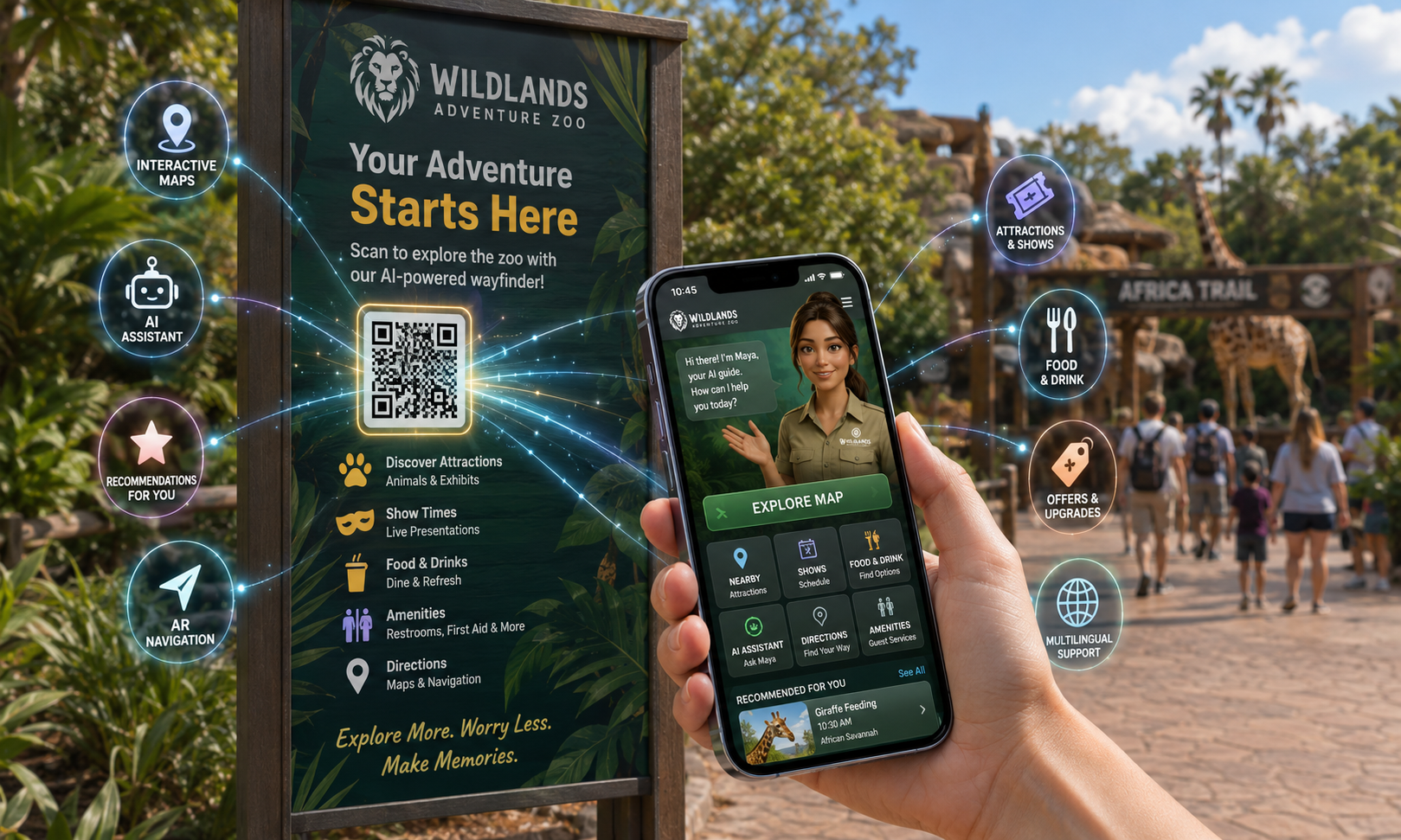
Interactive Wayfinder Experience
Campaign Type: AI-Enabled Visitor Wayfinding & Engagement Experience
Audience: Theme Park Visitors, Families & Tourists
Delivery Method: Interactive Signage Throughout the Park
Experience Type: AI Wayfinding Assistant + AR Navigation + Personalized Recommendations
Technologies: Dynamic QR Codes, Augmented Reality (WebAR), AI Chatbot, Landing Pages, Geo-Specific Content, Multilingual Content, Digital Retargeting, Reporting Dashboard
Overview
This Use Case illustrates how an Interactive Wayfinder could transform traditional theme park signage into an intelligent visitor assistance platform that does much more than show guests where attractions are located.
Theme parks are complex environments. Visitors may have dozens of rides, shows, restaurants, shops, amenities, and experiences to choose from, often spread across a large physical area.
A traditional park map can show visitors where everything is.
An Interactive Wayfinder could help them decide where they should go next.
By integrating Dynamic QR Codes into signs positioned throughout the park, visitors could instantly access an AI-enabled digital guide directly from their smartphone. They could find attractions and facilities, ask questions, receive recommendations based on their interests, discover nearby experiences, access AR navigation, explore dining options, or find relevant upgrades and promotions.
Rather than requiring visitors to download an app or repeatedly search through maps and websites, assistance would be available directly from the physical signage they encounter throughout their day.
The Interactive Wayfinder would therefore combine physical wayfinding, Augmented Reality, and Artificial Intelligence to create a more useful, contextual, and engaging visitor experience.
Campaign Background
Theme parks are designed around exploration and discovery, but the number of available experiences can also make navigating the day challenging.
Visitors may need to decide which attraction to visit next, where to eat, which shows are nearby, where particular facilities are located, or which experiences will best suit different members of their group.
Traditional maps and directional signage will remain essential for navigating these environments. However, they can only provide relatively static information.
They cannot easily answer questions such as:
“What’s nearby that my young children will enjoy?”
“Where should we eat?”
“What attractions would suit someone who doesn’t like thrill rides?”
“What else can we do in this area of the park?”
“Where should we go next?”
An Interactive Wayfinder would add an intelligent digital layer to existing signage.
Instead of simply displaying every available option, it could help visitors narrow those options based on their immediate needs, interests, preferences, and location.
This would transform wayfinding from a purely navigational function into a broader visitor engagement experience.
Challenge
In this illustrative scenario, launching an Interactive Wayfinder would aim to:
- Make large and complex venues easier to navigate
- Help visitors decide what to do next
- Provide immediate answers to common visitor questions
- Deliver recommendations based on visitor interests and preferences
- Make nearby attractions and experiences easier to discover
- Provide multilingual information and assistance
- Promote dining, retail, upgrades, and additional experiences
- Help influence visitor movement throughout the venue
- Reduce reliance on staff for routine directional enquiries
- Capture insight into what visitors are searching for and interested in
Traditional signage would continue to provide essential directional information.
The Interactive Wayfinder would extend its role by helping visitors make better decisions throughout their day.
Solution
The Interactive Wayfinder experience could function in the following way:
Interactive Signage
Dynamic QR Codes could be integrated into signs positioned throughout the theme park, including:
- Park directories
- Directional signage
- Attraction areas
- Dining precincts
- Entry and exit points
- Rest areas
- Information displays
- Transport and parking areas
Scanning the QR Code would launch a mobile-optimized experience directly in the visitor’s browser, with no app download required.
Because the experience could recognize which sign had been scanned, the starting content could be relevant to the visitor’s current location.
Interactive Park Map
Visitors could access an interactive map showing:
- Rides and attractions
- Shows and entertainment
- Restaurants and cafés
- Retail stores
- Restrooms
- First aid facilities
- Family facilities
- Rest and seating areas
- Entrances and exits
Instead of navigating a static map alone, visitors could select destinations and access additional information about each location.
AI Wayfinding Assistant
An integrated AI Assistant could allow visitors to ask questions conversationally rather than searching through menus and directories.
Questions could include:
- What should we do next?
- What attractions are nearby?
- What rides are suitable for younger children?
- Where can we get something to eat?
- What can we do if we only have two hours left?
- Where can we find a quieter place to take a break?
- What experiences should we not miss?
The AI Assistant could interpret the visitor’s request and help narrow the available options.
This would turn the Interactive Wayfinder from a simple information source into an intelligent visitor guide.
Personalized Recommendations
The experience could provide recommendations based on information voluntarily provided during the interaction, such as:
- Interests
- Age groups
- Preferred attraction types
- Dining preferences
- Accessibility requirements
- Available time
- Current location
A family with young children could therefore receive different recommendations from a group of adults looking for thrill rides.
The objective would not simply be to show visitors what is available, but to help identify what is most relevant to them.
AR Navigation
Augmented Reality could add a visual navigation layer to the physical environment.
After selecting a destination, visitors could use AR-enabled directional guidance to help navigate toward:
- Attractions
- Restaurants
- Shows
- Facilities
- Shops
- Other points of interest
This would make navigation more intuitive, particularly in large or unfamiliar environments where traditional maps can be difficult to interpret.
Nearby Attractions & Experiences
Because each sign could provide location-specific content, the Interactive Wayfinder could highlight relevant experiences nearby.
Visitors could discover:
- Rides they may otherwise overlook
- Upcoming shows
- Character experiences
- Nearby activities
- Dining options
- Retail locations
- Rest areas
This could encourage greater exploration while helping operators increase awareness of attractions across the venue.
Dining & Retail Discovery
Visitors could use the Interactive Wayfinder to explore:
- Nearby restaurants
- Food and beverage options
- Menus
- Dietary options
- Retail stores
- Merchandise
- Souvenirs
The experience could make it easier to find relevant options without requiring visitors to search separately.
Promotions, Upgrades & Additional Experiences
The Interactive Wayfinder could also introduce relevant commercial opportunities such as:
- Experience upgrades
- Premium attractions
- Special events
- Dining offers
- Merchandise promotions
- VIP experiences
- Limited-time offers
Because these offers could be presented contextually, they would become part of the visitor journey rather than disconnected advertising.
Multilingual Content
Visitors could select their preferred language and access:
- Directions
- Attraction information
- AI assistance
- Dining information
- Facility information
- General visitor guidance
This would make the same physical signage significantly more useful for international visitors without requiring extensive multilingual information to be printed on every sign.
Geo-Specific Content
Content could vary depending on where the Interactive Wayfinder was accessed.
A sign near a major attraction could prioritize nearby rides, shows, dining, and facilities, while a sign near the entrance could focus on orientation and recommended starting points.
This contextual relevance would help prevent visitors from being overwhelmed with unnecessary information.
Digital Retargeting
Where appropriate and subject to relevant consent requirements, visitors who engage with the experience could receive relevant follow-up digital content.
This could include:
- Upcoming events
- Return-visit promotions
- Membership opportunities
- Seasonal experiences
- Relevant offers
This would provide opportunities for the visitor relationship to continue beyond the initial interaction.
Engagement Reporting
Theme park operators could capture non-sensitive engagement insights including:
- Number of scans
- Sign locations generating engagement
- Popular destinations
- Frequently searched attractions
- Common AI questions
- Dining and retail interest
- Most-requested recommendations
- Language preferences
- Promotion and upgrade engagement
- Engagement duration
These insights could help operators better understand visitor needs and identify opportunities to improve signage, attraction discovery, visitor flow, and the overall guest experience.
Why Interactive Wayfinder Works
An Interactive Wayfinder would work because it would solve a problem traditional maps and signage cannot fully address.
Finding a destination is only one part of navigating a theme park.
Visitors also need to decide what to do, what is relevant to them, what is nearby, and how they can make the most of the time they have available.
Traditional signage will continue to provide essential visual direction. The Interactive Wayfinder would add intelligence and interaction to that existing touchpoint.
AI assistance would allow visitors to ask questions naturally. Personalized recommendations would help narrow the available choices. Geo-Specific Content would make those recommendations relevant to the visitor’s current location, while AR could make navigating toward the selected destination more intuitive.
The experience could also benefit operators.
By helping visitors discover attractions, restaurants, shops, and experiences throughout the venue, the Interactive Wayfinder could create opportunities to influence visitor flow and increase awareness of areas that might otherwise receive less attention.
At the same time, engagement data could provide greater insight into what visitors are looking for, the questions they are asking, and the experiences generating interest.
The result would be signage that does more than provide directions.
It would actively help visitors make better decisions throughout their day.
Conclusion
The Interactive Wayfinder would represent a significant evolution in theme park signage and visitor navigation.
By combining Dynamic QR Codes, Artificial Intelligence, Augmented Reality, Geo-Specific Content, and multilingual digital experiences, theme parks could transform traditional signs into intelligent visitor assistance points positioned throughout the venue.
For visitors, this would mean faster access to relevant information, easier navigation, more personalized recommendations, and less time trying to work out what to do next.
For operators, it would create opportunities to improve the visitor experience, increase attraction and offer discovery, influence visitor flow, and gain richer insight into guest interests and behaviour.
A traditional theme park sign can tell visitors where they are.
An Interactive Wayfinder could help them decide where to go next.
Contact Us if you’d like to learn more about implementing Interactive Wayfinder Experiences into your marketing.