
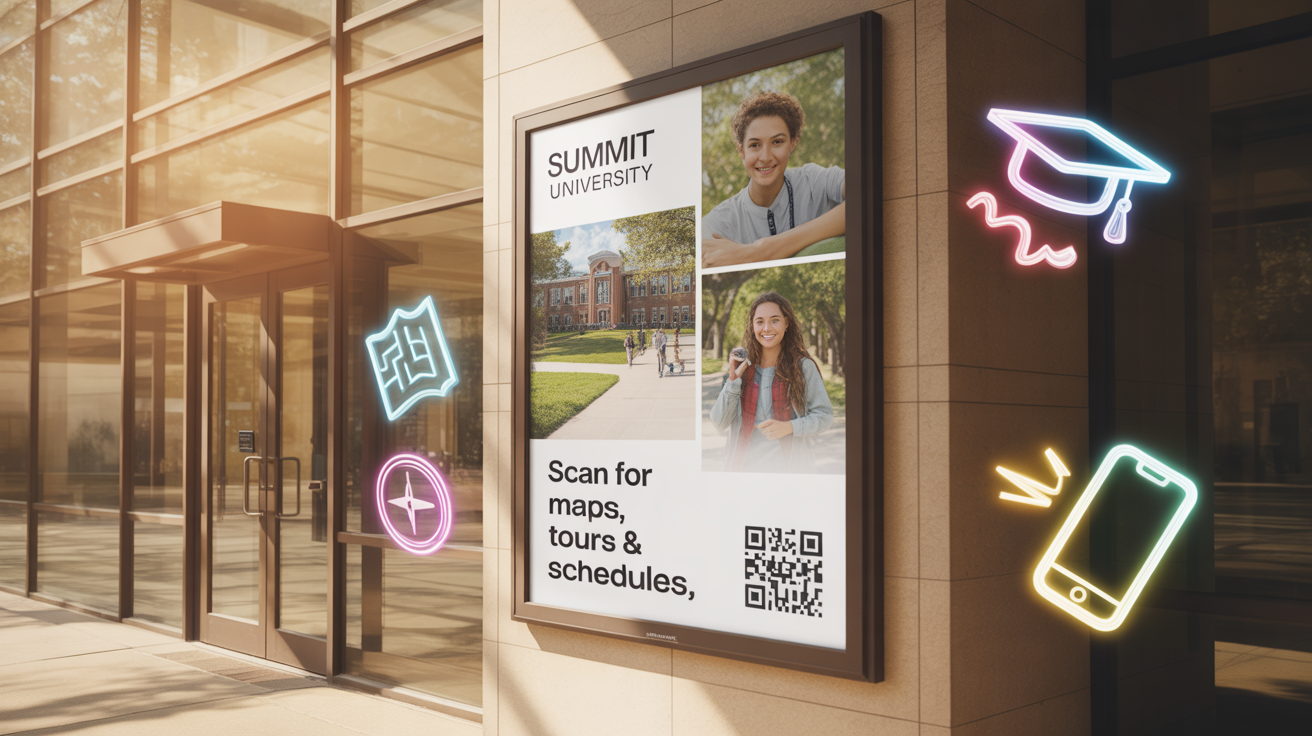
Interactive Education Signage
Campaign Type: Interactive Campus Engagement Signage
Audience: Prospective Students, Current Students & Campus Visitors
Delivery Method: Interactive Signage
Experience Type: Interactive Campus Maps + Orientation Content + Student Experience Videos
Technologies: Dynamic QR Codes, Augmented Reality (WebAR), Landing Pages, Geo-Specific Content, Digital Retargeting, Reporting Dashboard
Overview
This Use Case illustrates how Interactive Education Signage could transform traditional campus signs into engaging digital touchpoints that actively support the student experience.
Instead of functioning solely as static directional or informational displays, Interactive Education Signage would become an interactive gateway to campus resources, orientation tools, and digital content. By embedding Dynamic QR Codes into signage throughout a campus environment, students and visitors would be able to scan and instantly access maps, schedules, event information, course guides, and immersive campus experiences directly from their smartphones.
From first-time campus tours to ongoing student engagement, Interactive Education Signage would create a more connected and accessible educational environment. Rather than requiring visitors to search websites manually or rely on printed brochures alone, information would become immediately available at the point of need.
This approach would merge physical signage with interactive digital experiences, helping educational institutions deliver a modern, innovation-driven campus experience from the very first interaction.
Campaign Background
Educational institutions increasingly compete not only on academic offerings but also on student experience and campus engagement. Universities and colleges seek ways to create welcoming, connected, and technology-forward environments that reflect innovation and accessibility.
Traditional campus signage plays an important role in navigation and communication, but static signs often provide limited engagement. Students and visitors may still need to search websites, download maps, or visit multiple offices to access the information they need.
At the same time, modern students expect digital-first experiences that are intuitive, immediate, and mobile-friendly.
Interactive Education Signage would address these expectations by transforming campus signs into interactive information hubs. Rather than functioning only as directional markers, signs would become gateways to real-time campus content and immersive digital experiences.
This evolution would allow educational institutions to create a smarter and more connected campus journey — one that supports navigation, communication, and engagement simultaneously.
Challenge
In this illustrative scenario, launching Interactive Education Signage would aim to:
- Improve campus navigation and accessibility
• Deliver important information instantly at the point of need
• Enhance orientation and campus tour experiences
• Provide engaging digital experiences for prospective students
• Reflect innovation and modern campus culture
Traditional signage provides visibility but limited interaction. Interactive Education Signage would be designed to bridge this gap by combining physical presence with mobile-first digital engagement.
Solution
The Interactive Education Signage campaign could function in the following way:
Interactive Campus Signage
Campus signs placed throughout key locations would feature clearly integrated Dynamic QR Codes designed for instant smartphone access.
These signs could be positioned at:
- Entry points
• Orientation zones
• Faculty buildings
• Student hubs
• Event spaces
• Accommodation areas
Interactive Campus Maps
Scanning the signage could launch interactive campus maps that help users navigate the environment in real time.
These maps could include:
- Walking directions
• Building locations
• Parking information
• Accessibility routes
• Guided campus tours
This would reduce confusion and improve the visitor experience.
Orientation & Schedule Information
Interactive Education Signage could also provide immediate access to:
- Orientation schedules
• Event calendars
• Open day information
• Timetable details
• Student support resources
Because the Landing Page content could be updated dynamically, information would remain current without needing to replace printed signage.
Prospectus & Course Guide Downloads
Prospective students could instantly download:
- Digital prospectuses
• Course guides
• Faculty brochures
• Enrollment information
This would simplify information access while reducing dependence on printed handouts.
Student Experience Videos
The interactive experience could include video content such as:
- Student testimonials
• Campus lifestyle highlights
• Faculty introductions
• Welcome messages from university leadership
These videos would create a more personal and engaging connection with prospective students.
Geo-Specific Content
Content could adapt based on the sign location. For example:
- Engineering building signs could showcase engineering programs
• Sports precinct signs could highlight athletic facilities
• Accommodation signage could provide housing details
Geo-Specific Content would increase relevance and contextual engagement.
Digital Retargeting
Visitors who engage with Interactive Education Signage could receive follow-up digital communication aligned with their interests. This would help extend engagement beyond the initial campus visit.
Engagement Reporting
Scan activity, content views, downloads, and engagement duration could be tracked through a Reporting Dashboard. These insights would help institutions refine campus communication strategies and improve visitor experiences.
Why Interactive Education Signage Works
Interactive Education Signage would combine the visibility and accessibility of physical signage with the immediacy and flexibility of digital engagement.
Traditional campus signs are useful for navigation but often limited in depth. By layering Dynamic QR Codes and mobile-first experiences onto signage, institutions would create a more connected and interactive environment.
Interactive campus maps would improve accessibility. Orientation content would simplify onboarding. Video experiences would humanize the institution and strengthen emotional connection.
Because content could update dynamically, signage would remain useful and current throughout the academic year without requiring constant reprinting.
Rather than functioning as static informational displays, Interactive Education Signage would become active engagement tools that support navigation, communication, and campus experience simultaneously.
Conclusion
Interactive Education Signage would represent a meaningful evolution in campus communication and student engagement. By integrating Dynamic QR Codes, interactive maps, digital downloads, and immersive content into everyday signage, educational institutions could create smarter, more connected campus environments.
Instead of serving only as directional markers, Interactive Education Signage would become interactive gateways that guide, inform, and engage students and visitors in real time.
In modern education environments, Interactive Education Signage would not be viewed as an enhancement to campus communication. It would become the new standard for delivering connected, mobile-first student experiences that reflect innovation from the very first interaction.
Contact Us if you’d like to learn more about implementing Interactive Signage into your marketing.