
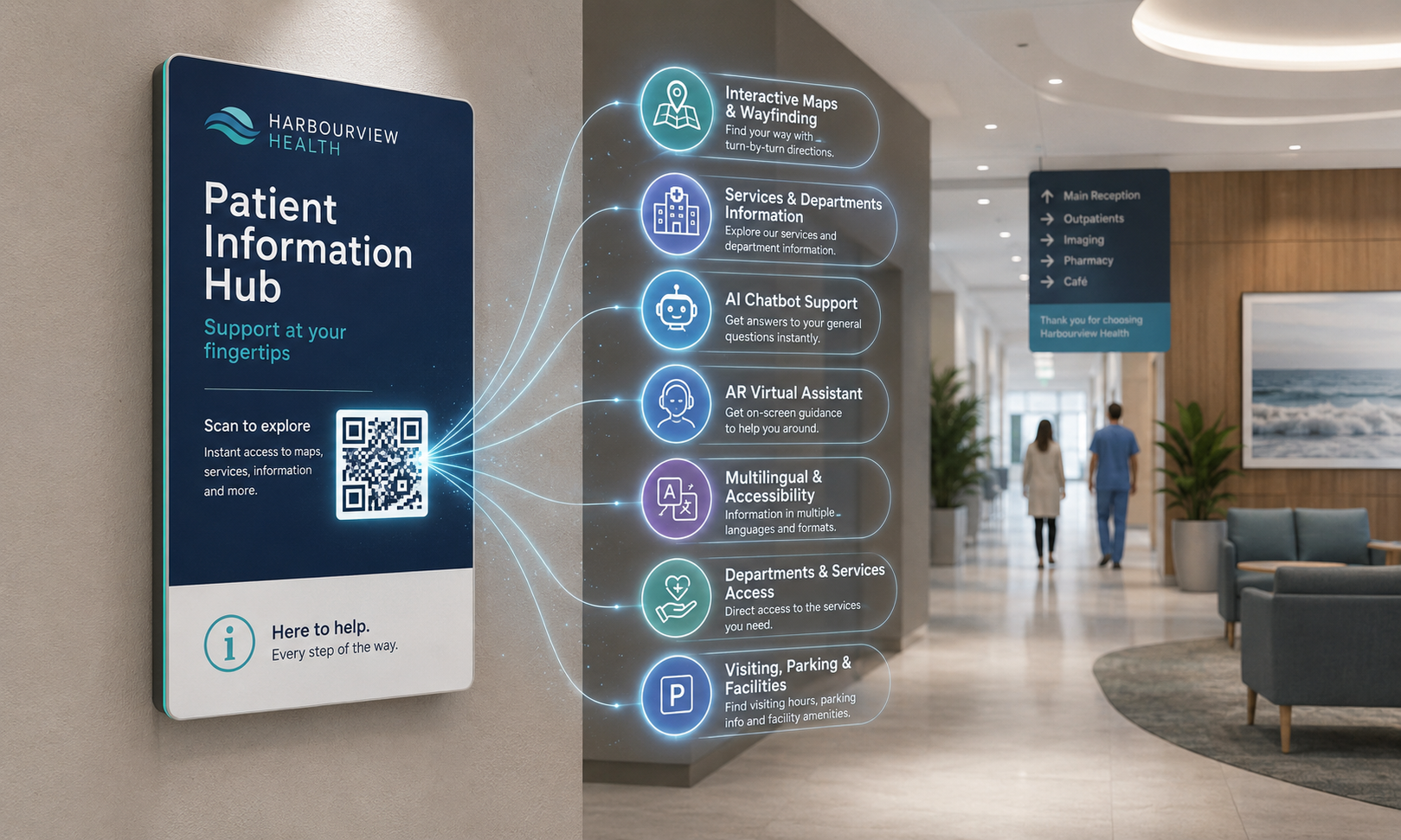
Interactive Healthcare Signage
Campaign Type: Interactive Patient & Visitor Support Signage
Audience: Patients, Visitors & Caregivers
Delivery Method: Healthcare Signage
Experience Type: Interactive Wayfinding + AI Support + AR Virtual Assistant
Technologies: Dynamic QR Codes, AI Chatbot, AR Avatar, Landing Pages, Geo-Specific Content, Multilingual Content, Reporting Dashboard
Overview
This Use Case illustrates how Interactive Healthcare Signage could transform everyday hospital and clinic signage into convenient digital support points for patients, visitors, and caregivers.
Healthcare facilities rely heavily on signage to help people navigate unfamiliar environments, locate departments, understand available services, and access essential information. However, traditional signage is limited by space and can only communicate a relatively small amount of static information.
Interactive Healthcare Signage would extend that capability.
By integrating Dynamic QR Codes into existing signs, patients and visitors could scan and instantly access interactive maps, department information, visiting hours, parking details, accessibility resources, multilingual content, an AI Chatbot for general questions, or an AR Virtual Assistant that helps guide the experience.
No app download would be required, and users would not need to search through complex websites to find basic information.
Rather than serving only as directional markers, Interactive Healthcare Signage would become an always-accessible information and support layer throughout the healthcare environment.
Campaign Background
Hospitals, clinics, medical centers, and other healthcare facilities can be complex environments to navigate.
Patients and visitors may arrive feeling unfamiliar with the facility, uncertain about where they need to go, or under time pressure. Large campuses may contain multiple buildings, departments, entrances, parking areas, waiting rooms, and support services.
Traditional wayfinding signs remain essential, but they cannot answer every question.
A sign may direct someone toward Radiology, for example, but it may not explain which entrance to use, what facilities are nearby, where to park, or how to contact the department. Visitors may then need to locate a reception desk, ask staff for directions, or search through a healthcare provider’s website.
Interactive Healthcare Signage would help close this information gap.
By connecting physical signs with mobile digital experiences, healthcare providers could make useful information available exactly where people need it. The sign would continue performing its traditional wayfinding role while also offering deeper, optional support through a simple scan.
This would allow healthcare facilities to improve accessibility and convenience without requiring additional physical signage for every possible information need.
Challenge
In this illustrative scenario, launching Interactive Healthcare Signage would aim to:
- Make healthcare facilities easier to navigate
- Provide fast access to general patient and visitor information
- Reduce reliance on staff for routine directional and facility enquiries
- Support multilingual and accessibility requirements
- Improve access to department and service information
- Keep frequently changing information current
- Deliver a more connected patient and visitor experience
- Provide useful engagement insights without exposing sensitive patient information
Traditional signage is effective for basic directions, but it cannot easily adapt to different languages, changing information, or individual visitor needs.
Interactive Healthcare Signage would be designed to extend the usefulness of existing signs without replacing the clarity and simplicity required in healthcare wayfinding.
Solution
The Interactive Healthcare Signage experience could function in the following way:
Interactive Signage Access
Signs positioned throughout the facility could feature clearly integrated Dynamic QR Codes.
These could appear on:
- Entrance and lobby signage
- Department directories
- Corridor wayfinding signs
- Parking signage
- Waiting area displays
- Visitor information boards
- Elevator and floor directories
Scanning the QR Code would open a mobile-optimized experience directly in the user’s browser, with no app download required.
Interactive Maps & Wayfinding
Patients and visitors could access interactive maps showing:
- Departments and services
- Building locations
- Entrances and exits
- Parking facilities
- Elevators and stairs
- Restrooms
- Cafés and waiting areas
- Accessible routes
The experience could help users understand where they are and how to reach the relevant destination more easily.
Department & Service Information
Interactive Healthcare Signage could provide general information about:
- Departments
- Available services
- Opening hours
- Contact details
- Check-in locations
- General preparation information
- Relevant facility information
This would allow people to obtain useful guidance without searching manually across multiple webpages.
AI Chatbot Support
An integrated AI Chatbot could answer general, non-clinical questions such as:
- Where is a particular department?
- What are the visiting hours?
- Where can visitors park?
- Is there a café nearby?
- How can a department be contacted?
- Where are accessible entrances located?
The AI Chatbot would be designed specifically for general information and navigation rather than providing medical advice, diagnosis, or access to private patient information.
AR Virtual Assistant
An AR Virtual Assistant could provide an additional layer of guidance.
The AR Avatar could:
- Welcome visitors
- Explain how to navigate the facility
- Highlight nearby services
- Introduce departments
- Provide general facility information
- Guide users toward appropriate resources
This could make the experience more approachable while reducing the need to navigate complex menus.
Multilingual Information
Interactive Healthcare Signage could provide language options that allow patients and visitors to access the same information in multiple languages.
Instead of producing separate physical signs for every language, the digital experience could dynamically present translated:
- Directions
- Department information
- Visitor guidelines
- Facility information
- General support content
This would help healthcare providers serve more diverse communities without overcrowding physical signage.
Accessibility Resources
The experience could also make accessibility information easier to find, including:
- Accessible entrances
- Wheelchair routes
- Elevator locations
- Accessible parking
- Hearing assistance information
- Other available support services
This would allow visitors to identify appropriate routes and resources before reaching their destination.
Visiting, Parking & Facility Information
Interactive Healthcare Signage could provide direct access to commonly requested information such as:
- Visiting hours
- Parking options
- Drop-off zones
- Public transport information
- Food and beverage facilities
- Pharmacy locations
- General visitor policies
Because this information would be delivered digitally, it could be updated without replacing the original signage.
Direct Department Access
Where appropriate, the experience could provide one-tap access to relevant departments and services.
Customers could:
- Call a department
- Open the relevant service webpage
- View general departmental information
- Access approved online resources
This would reduce unnecessary searching and make the pathway to the correct information more direct.
Geo-Specific Content
Within larger healthcare campuses, content could adapt based on the location of the sign being scanned.
For example, signage near an outpatient building could prioritize information relevant to nearby departments, while parking signage could provide directions from that specific location.
This would make the experience more contextual and useful.
Engagement Reporting
Healthcare providers could capture non-sensitive engagement information such as:
- Number of scans
- Most-accessed information
- Frequently used language options
- Popular wayfinding destinations
- Frequently asked general questions
- Engagement duration
These insights could help facilities understand where information gaps exist and improve future signage and visitor communication strategies.
Why Interactive Healthcare Signage Works
Interactive Healthcare Signage would work because it would enhance a touchpoint healthcare facilities already rely on every day.
The objective would not be to replace traditional signs. Clear physical wayfinding would remain essential. Instead, Interactive Healthcare Signage would add an optional digital layer for people who need more information or assistance.
Interactive maps would provide greater navigation depth. AI Chatbots could answer routine questions instantly. AR Virtual Assistants could make guidance more engaging and accessible. Multilingual content would help support diverse communities, while digital updates would allow important information to remain current.
The experience would also be available at the exact point where the need occurs.
A patient standing beside a directory would not need to search a website. A visitor in a parking area would not need to locate an information desk. A caregiver looking for visiting information could access it immediately from the relevant sign.
Rather than adding another communication touchpoint, Interactive Healthcare Signage would make existing touchpoints work harder.
PII & HIPAA Data Compliance
Interactive Healthcare Signage would be designed primarily for general information, navigation, and visitor support rather than the collection or display of sensitive patient information.
The experience would not need to access medical records, diagnoses, treatment information, appointment details, or other protected health information to perform its core functions.
AI Chatbot interactions would be limited to approved general information and non-clinical support, and users would not be encouraged to submit confidential medical or personal information.
Where data is collected for reporting, the focus would remain on anonymous or aggregated engagement activity such as scans, content views, language selection, and information requests.
This approach would allow healthcare providers to improve convenience and accessibility while maintaining clear boundaries around privacy, security, and patient confidentiality.
Conclusion
Interactive Healthcare Signage would represent a practical evolution in patient and visitor communication.
By integrating Dynamic QR Codes, interactive maps, AI-powered general support, AR Virtual Assistants, multilingual information, and accessible digital resources into existing signage, healthcare providers could make facilities easier to navigate and important information easier to access.
For patients and visitors, the experience would provide fast, convenient assistance without requiring an app download or lengthy website search.
For healthcare providers, it would create an opportunity to reduce routine enquiries, improve accessibility, and deliver a more connected visitor experience without compromising patient privacy.
Interactive Healthcare Signage would not replace the signs healthcare facilities already depend on.
It would make those signs significantly more useful.
Contact Us if you’d like to learn more about implementing Interactive Healthcare Signage into your business.