
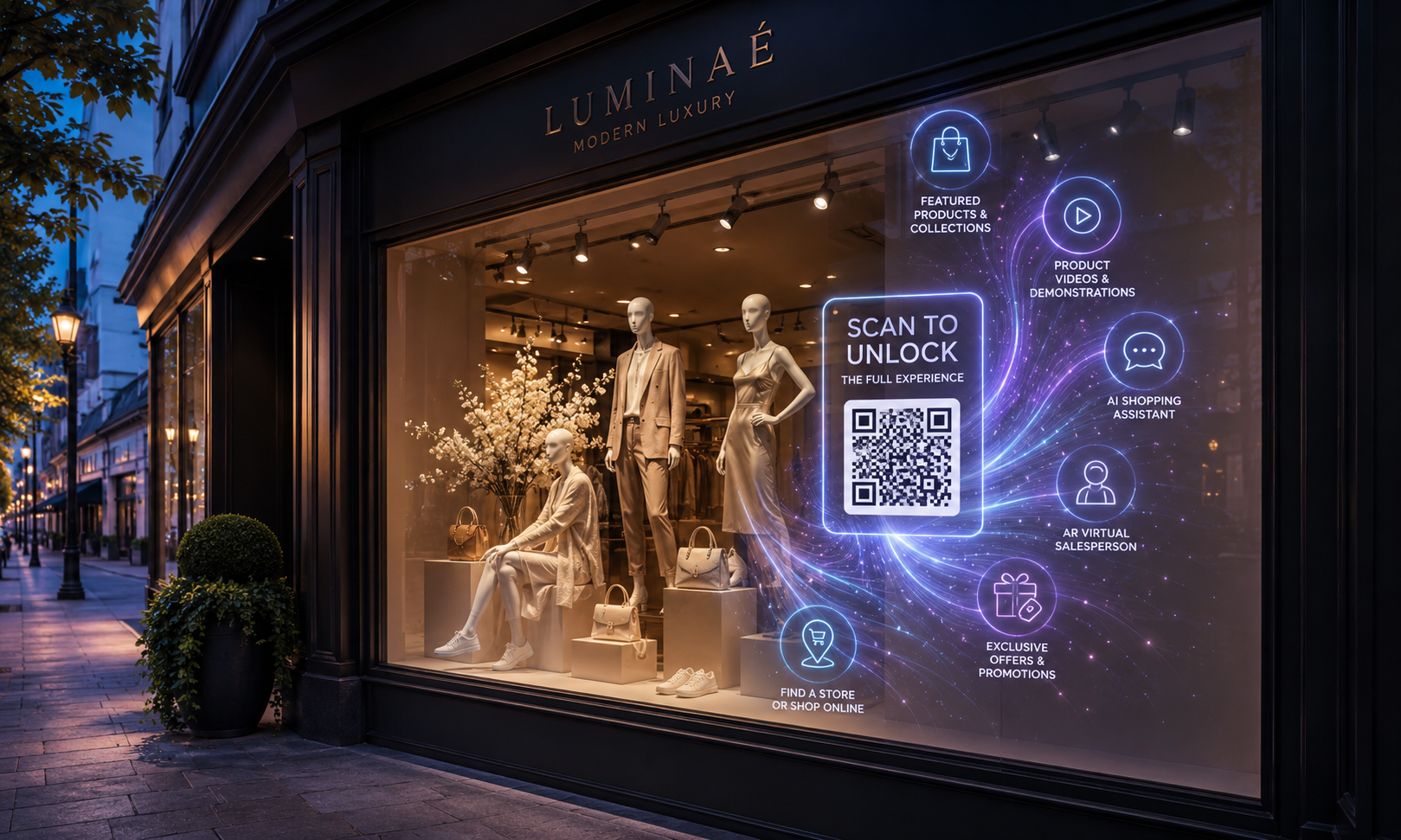
Interactive Retail Signage
Campaign Type: Interactive Window Display Campaign
Audience: Retail Shoppers, Passersby & Prospective Customers
Delivery Method: Retail Window Signage & Displays
Experience Type: AR Virtual Salesperson + AI Shopping Assistant + Interactive Product Discovery
Technologies: Augmented Reality (WebAR), Dynamic QR Codes, AR Avatar, AI Chatbot, Landing Pages, Geo-Specific Content, Digital Retargeting, Reporting Dashboard
Overview
This Use Case illustrates how Interactive Retail Signage could transform traditional shop windows into always-on customer engagement and shopping experiences.
Retail window displays already play an important role in attracting attention, showcasing products, and communicating brand identity. However, most window displays remain passive. They can inspire interest, but they cannot answer questions, provide detailed product information, recommend alternatives, or help customers complete a purchase.
Interactive Retail Signage would change that.
By integrating Dynamic QR Codes into window graphics, posters, or display panels, retailers could allow shoppers to scan and immediately access an interactive digital experience from their smartphone. One quick scan could launch an AR Virtual Salesperson, connect the shopper to an AI Shopping Assistant, open product demonstrations, reveal exclusive promotions, or provide direct access to online purchasing.
This experience could remain available outside normal trading hours, allowing the shop window to continue informing and converting customers even when the store is closed.
Rather than serving only as a visual display, Interactive Retail Signage would become an always-accessible digital sales and engagement channel.
Campaign Background
Retail windows are among the most valuable physical marketing assets available to stores. They occupy premium street-facing space, reach high volumes of passing traffic, and help shape the first impression of the brand.
During business hours, a compelling display may encourage customers to enter the store. Outside business hours, however, the same display can only create awareness. A shopper may see a product they like, but there may be no immediate way to learn more, ask questions, check availability, or make a purchase.
This creates a missed opportunity.
Consumer shopping behaviour has also evolved. Customers increasingly expect instant access to product information, recommendations, reviews, videos, availability, and purchasing options. They are accustomed to digital convenience and may be less willing to delay action or search for products manually after leaving the storefront.
Interactive Retail Signage would connect the physical window display directly to a mobile shopping experience. Instead of asking customers to remember the product or return later, the signage would allow them to take immediate action at the point of interest.
This would give retailers a practical way to extend the commercial value of every shop window while creating a more convenient and memorable experience for shoppers.
Challenge
In this illustrative scenario, launching Interactive Retail Signage would aim to:
- Extend the value of shop windows beyond store opening hours
- Turn passing interest into measurable engagement
- Provide immediate access to product information and demonstrations
- Help customers make more confident purchasing decisions
- Connect physical retail displays with online shopping pathways
- Deliver instant support without requiring in-store staff
- Promote relevant offers based on store, campaign, or location
- Capture insight into which displays and products generate interest
Traditional window displays attract attention but provide limited interaction. Interactive Retail Signage would be designed to bridge that gap by transforming visual interest into an immediate digital journey.
Solution
The Interactive Retail Signage campaign could function in the following way:
Interactive Window Display
Each shop window would feature a clearly visible Dynamic QR Code integrated into the display, poster, decal, or promotional signage.
The code would invite shoppers to explore the products and experiences featured in the window.
No app download would be required.
The QR code would act only as the access point. The value would come from the interactive customer experience delivered after the scan.
Interactive Product Exploration
Scanning the signage could allow shoppers to explore:
- Featured products
- New collections
- Seasonal ranges
- Product bundles
- Best-selling items
- Limited-edition releases
Instead of being restricted to the products physically displayed in the window, customers could browse a broader digital collection aligned with the campaign.
Product Demonstrations & Videos
Customers could access product content such as:
- Demonstration videos
- Product feature highlights
- Styling inspiration
- How-to content
- Comparison videos
- Behind-the-scenes brand stories
This would help customers understand the product in greater detail while strengthening confidence and purchase intent.
AR Virtual Salesperson
An AR Virtual Salesperson could welcome the shopper and guide the experience.
The AR Avatar could:
- Introduce featured products
- Explain key benefits
- Highlight promotions
- Recommend related items
- Direct customers to purchase options
- Encourage customers to visit the store
This would bring a human element to the experience, even when no staff member is available.
AI Shopping Assistant
An integrated AI Shopping Assistant could answer shopper questions in real time.
Customers could ask questions such as:
- Is this product available in another size or colour?
- Which item would suit a particular need?
- What is the difference between these two products?
- Is this available at another location?
- Which accessories match this product?
- Can this item be purchased online?
The AI Shopping Assistant would provide immediate support without requiring customers to search through multiple pages or wait until the store reopens.
Exclusive Offers & Promotions
Interactive Retail Signage could unlock:
- Window-exclusive promotions
- Limited-time discounts
- Loyalty rewards
- Competition entries
- New-customer offers
- Product bundle incentives
Because the destination content could be updated dynamically, offers could change throughout the campaign without replacing the physical signage.
Store Locator & Local Availability
The experience could help customers:
- Find the nearest store
- Check opening hours
- View local product availability
- Access directions
- Reserve products for collection
- Locate nearby stock
Geo-Specific Content would allow the experience to adapt based on the customer’s location and the store being viewed.
Online Purchase Pathways
Shoppers could move directly from the window display to:
- Product detail pages
- Add-to-cart functions
- Online checkout
- Click-and-collect options
- Wish lists
- Product reservation
This would reduce the number of steps between initial interest and purchase.
Digital Retargeting
Customers who interact with Interactive Retail Signage could receive relevant follow-up advertising based on the products or categories they explored.
This would allow retailers to extend the relationship beyond the initial storefront interaction and reinforce product interest across digital channels.
Engagement Reporting
Retailers could capture insights including:
- Number of scans
- Most-viewed products
- AR Avatar engagement
- AI Shopping Assistant conversations
- Product video views
- Offer interactions
- Store locator activity
- Online purchase pathways
- Engagement duration
These insights would help retailers understand which windows, products, and campaigns generate the strongest customer interest.
Why Interactive Retail Signage Works
Interactive Retail Signage would work because it would connect physical attention with immediate action.
Shop windows already attract interest. The challenge is that traditional displays often leave customers with no clear next step, particularly outside business hours.
By integrating Dynamic QR Codes, AR Virtual Salespeople, AI Shopping Assistants, product content, and purchasing pathways into window signage, retailers could create a seamless transition from physical discovery to digital engagement.
The AR Virtual Salesperson would provide guidance and personality. The AI Shopping Assistant would answer questions instantly. Product videos would provide depth, while online checkout and click-and-collect options would reduce friction.
Geo-Specific Content would ensure customers receive relevant local information, while Digital Retargeting would allow engagement to continue after they leave the storefront.
Most importantly, Interactive Retail Signage would enable the window display to continue working around the clock.
Rather than functioning only as a visual marketing asset, it would become an interactive retail channel capable of informing, assisting, and helping customers buy.
Conclusion
Interactive Retail Signage would represent a meaningful evolution in retail window marketing.
By combining Dynamic QR Codes, AR Virtual Salespeople, AI-powered shopping assistance, product videos, Geo-Specific Content, and direct purchasing pathways, retailers could transform traditional shop windows into always-on customer engagement experiences.
For shoppers, the experience would provide immediate access to information, assistance, offers, and purchasing options at the exact moment interest is created.
For retailers, it would extend the value of every window display, generate richer engagement insight, and create more opportunities to turn passing attention into meaningful action.
Window displays would no longer stop at attracting attention.
With Interactive Retail Signage, they would help inform, engage, and sell long after the store doors close.
Contact Us if you’d like to learn more about implementing Interactive Retail Signage into your marketing.